
to standard time early this morning (at 2 am). Don't forget to set your clocks back one hour, and enjoy the extra hour of sleep. Learn more about daylight saving time.
I'm conflicted about the change back to standard time. Being a morning person I certainly enjoy the extra hour of light early in the day, but at northern latitudes the darkness descends entirely too early. One big advantage is that the evening stars pop out earlier for observation.
Sunday, November 1, 2009


Saturday, October 31, 2009
Apollo 17 lunar landing site...
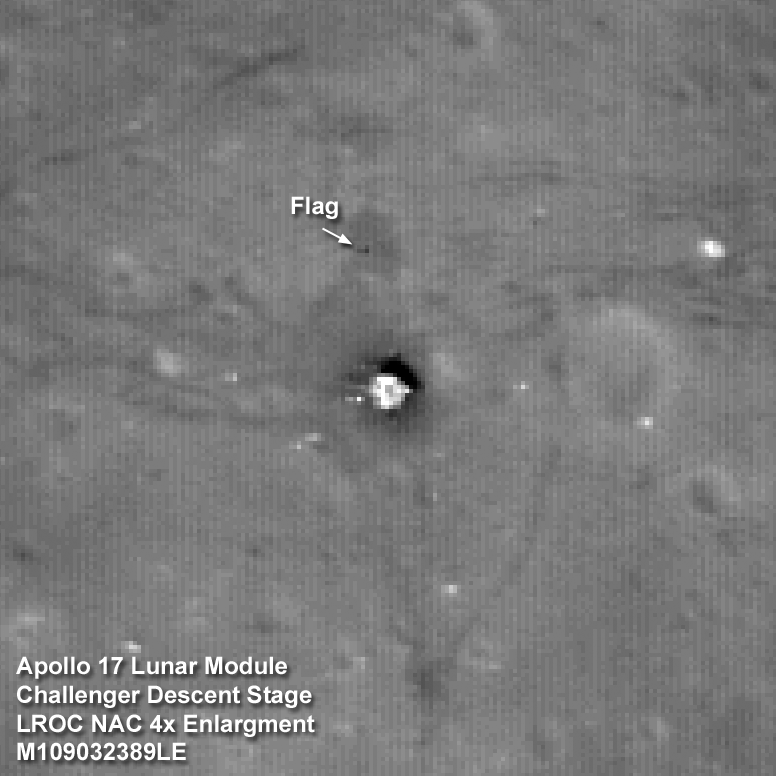 revealed in stunning detail in latest LRO images (click to enlarge). The descent stage of the lunar module Challenger, and footprints by astronauts Gene Cernan and Jack Schmitt - the only geologist to fly to the Moon - as well as various scientific instruments, show clearly in the high-resolution images of the last place we visited on our nearest neighbor in 1972.
Previous related posts here and here.
An inconvenient set of facts...
shows that the North Atlantic hurricane season is the slowest since 1997, and that the global and northern hemisphere tropical cyclone activity remains near 30-year historical lows. This stands in stark contrast to predictions that global warming would increase storm frequency and intensity. Hmm, and I thought the debate was over.
Mr. Gore, do you have a comment?
Mr. Gore, do you have a comment?
Zoom through orders of magnitude...
of scale from a coffee bean - millimeters - to a carbon atom - picometers - at this web page: Cell Size and Scale. Just grab the slider below the graphic, move it incrementally to the right, and go along for the ride. Zoom zoom!
Very, very cool.
Very, very cool.

Friday, October 30, 2009
Local weather prognosticator...
predicts mild winter:
"Quinn expects the winter of 2009-10 to produce about 25 inches of snow in places like Cheney. 'That’s half to less than half of normal snowfall at lower elevations,' he said."I'd warn you, however, not to bank on this. EWU geography professor Quinn was in error by more than 100 percent in his forecast for last winter when the Spokane region received nearly 94" of snow.
"Norwegian Fjords to Spitsbergen"...
photo-journal that documents my travels with Zegrahm Expeditions above the Arctic Circle this last summer is now on-line (the link takes you to a 2.54 MB .pdf file). About a third of the images featured in this book that was provided to passengers on the voyage were taken by your humble correspondent.
Take a look, people who like to take looks.
Take a look, people who like to take looks.
Landslide season commences...
in the Seattle area: What homeowners can do to prevent problems. While the primary natural trigger is water-saturated soils, here's a revealing fact from the linked article:
"A city landslide study found that 86 percent of landslides were caused by human activity such as excavation, fill placed on steep slopes, broken pipes and uncontrolled stormwater."Recent years haven't been as bad as the winter of 1996-1997 which this on-line report details: Landslides Triggered by the Winter 1996-97 Storms in the Puget Lowland, Washington.
Thursday, October 29, 2009
"Yuppie 911" causing problems...
for rescue agencies: personal locator beacons make it (too) easy to summon help.
My personal perspective is that these gadgets allow for ill-equipped and inexperienced people to push beyond their capabilities. Frivolous use of the system should be met with stiff fines as well as compensating all costs associated with the "rescue."
My personal perspective is that these gadgets allow for ill-equipped and inexperienced people to push beyond their capabilities. Frivolous use of the system should be met with stiff fines as well as compensating all costs associated with the "rescue."
You must forego hot showers...
in order to save the planet. If you don't then you're a bad person. And stinky.
Wednesday, October 28, 2009
Successful launch of the Ares I-X...
rocket occurred this morning at ~8:30 am PDT. Read more here.
UPDATE: Here's a video of the lift-off.
UPDATE: Here's a video of the lift-off.
Great gourd grabs the record...
and squashes previous enormous squash: Giant Pumpkin Breaks Record. The subject of the linked article, grown in Ohio, attained 1,725 pounds at the time of harvest.

Tuesday, October 27, 2009
Isn't that special...
Dinosaur Museum Presents Biblical View of Origins
Hat tip: Geogal.
"We are totally different from the Museum of the Rockies in that we present fossils and all the exhibits in the context of biblical creation," said Otis E. Kline Jr., the museum's founder and director.
It's ironic that this so-called museum exists smack in the middle of an area in western Montana rich with paleontological sites that have yielded tremendous scientific information about dinosaurs. But perhaps that's exactly why it is there.Jack Horner, the curator of paleontology at the Museum of the Rockies, agrees the two museums are fundamentally different.
"It's not a science museum at all," Horner said. "It's not a pseudo-science museum. It's just not science. …There's nothing scientific about it."
Hat tip: Geogal.
Ugly bats have...
 quite the chompers. Indeed, the wrinkle-faced bat (Centurio senex; shown above - click to enlarge) is less than attractive, but calling it ugly only hurts its self esteem.
Remember: bats need friends.
Weather delays launch...
of the Ares I-X rocket. NASA just announced that they are scrubbing today's test launch. The next attempt to put this new rocket in the air will occur tomorrow at 5:00 am PDT.
Monday, October 26, 2009
Old and new are side by side...
 at the Kennedy Space Center, Florida. The image above (click to enlarge) shows the space shuttle Atlantis on pad 39A (foreground) and the Ares I-X on pad 39B (background) during the rare circumstance of two different launch vehicles being readied for lift-off at nearly the same time.
Entrance into a possible...
 Martian microbial underworld imaged on Arsia Mons (click to enlarge) that is estimated to be 160 to 200 ft (50 - 60 m) across. It is hypothesized that this is a skylight into a lava tube that could potentially protect life - if it exists - from "radiation, extreme temperatures and dust storms" that occur on the surface of Mars.
Link to technical abstract.
Image credit: NASA/JPL.
Ares I-X test launch...
is in nominal launch condition for its scheduled lift-off at 5:00 am PDT tomorrow morning, though developing bad weather may be a factor.
Previous related post about NASA's next generation launch vehicle.
Previous related post about NASA's next generation launch vehicle.
An image of Earth...
 from space showing the expansive Snake River Plain (click to enlarge). Where to begin to highlight the various physiographic and geologic features shown on this satellite image?
The Snake River scribes a meandering course as it flows westward across the volcanic plains, with irrigated farmlands adjacent to the mostly incised channel. That's Yellowstone National Park near the upper right, with the Great Salt Lake - and associated salt flats - in the lower center. The geologic structures associated with the Basin and Range Province are easily seen both north and south of the Snake River Plain.
Image credit: MODIS Rapid Response Team at NASA GSFC; acquired 29 August 2008.
Wise words...
Science is an integral part of culture. It's not this foreign thing, done by an arcane priesthood. It's one of the glories of the human intellectual tradition.
-- Stephen Jay Gould
-- Stephen Jay Gould
Sunday, October 25, 2009
That'll teach you...
to drive your furniture while under the influence: Man Pleads Guilty To DWI In Motorized La-Z-Boy.
Hat tip: RO'Q
Previous related post involving drunken driving on a bar stool. For goodness sake, don't drink and drive (even furniture).
Hat tip: RO'Q
Previous related post involving drunken driving on a bar stool. For goodness sake, don't drink and drive (even furniture).
Spelean flowstone river ...
is world's longest speleothem: World's longest cave formation still growing. The mineral deposit in Fort Stanton Cave, New Mexico, dubbed Snowy River, is 7.5 km long and is no older than 850 years. Here's the technical abstract.
The annual Halloween party...
hosted by EWU's Dean of the College of Science and his wife is fast becoming a tradition, and I'm on the A-list of invitees for some reason. Everyone is required to wear a costume, and here are some pics (click to enlarge) of various faculty from the event held last night (names are being withheld to protect the potentially embarrassed):




Saturday, October 24, 2009
So-called "net neutrality" rules...
have been drafted by the Federal Communications Commission (FCC) that govern wired and wireless broadband connections to the Internet. I'm just getting up to speed with this important issue and have found the following helpful:
Historic window into...

Here's a previous related post about the Spokane Valley - Rathdrum Prairie aquifer.
Top ten scientific...
music videos from Wired.com. My favorite is "The Nano Song" but the "Large Hadron Rap" is pretty creative.
Friday, October 23, 2009
Rainy day for a geology field trip...
but the weather you get is the weather you get (that's almost Zen-like).
I'm presenting a lecture about the geology of the Missoula Floods in the Spokane area this morning, then leading an afternoon field trip for the Inland Empire Chapter of the Soil and Water Conservation Society. If the weather cooperates, and I get a good pic or two, I'll post them here as an evening update.
I'm presenting a lecture about the geology of the Missoula Floods in the Spokane area this morning, then leading an afternoon field trip for the Inland Empire Chapter of the Soil and Water Conservation Society. If the weather cooperates, and I get a good pic or two, I'll post them here as an evening update.
Window into lunar lava tube discovered...
during close scrutiny of recent imagery: Found -- First 'Skylight' on the Moon.
This is the first of a great many, I suspect, though many tube entrances are likely buried by ejecta or collapsed regolith.
This is the first of a great many, I suspect, though many tube entrances are likely buried by ejecta or collapsed regolith.
Thursday, October 22, 2009
Major reversal...
regarding the remains of Everett Ruess: Navajos to reclaim bones misidentified as poet's.
National Geographic, the long-accepted arbiter of accurate information, needs to reassess its fact-checking, in my opinion. This is a gross failure in scientific analysis and reportage.
Previous related posts here and here.
Hat tip: LS (thanks, neighbor, for keeping me informed about this interesting controversy).
National Geographic, the long-accepted arbiter of accurate information, needs to reassess its fact-checking, in my opinion. This is a gross failure in scientific analysis and reportage.
Previous related posts here and here.
Hat tip: LS (thanks, neighbor, for keeping me informed about this interesting controversy).
70 years of radio astronomy...
and the telescopes behind the science: an image gallery from Wired.com. My favorite is The Very Large Array on the Plains of San Augustin in New Mexico, and I've visited the facility several times during my travels through the area.
Wednesday, October 21, 2009
So it's not Everett Ruess...
after all: Remains Found in Utah Not Poet Everett Ruess. Hmm. The article is short on details so it's hard to know what to think about this 75 year-old mystery.
Previous related post (a must read in light of this latest bit of news.)
Hat tip: LS
Previous related post (a must read in light of this latest bit of news.)
Hat tip: LS
The first exam in sed/strat...
 is tomorrow, Thursday, at 11 am. Good luck to my fledgling sedimentologists; be sure to study hard tonight.
This will give you nightmares...
for sure, and just in time for Halloween: Even-More-Gigantic Giant Orb Spider Discovered. The female arachnid is about five inches in diameter, the size of a CD/DVD (images at the link).
Take a look, people who like to take looks.
Take a look, people who like to take looks.
The Internet is altering our brains...
according to a recent neurological study at UCLA, and for the better it seems, resulting in "cognitive enhancement in older adults". Here's the abstract for those who have the cognitive abilities to understand it: Neural activation patterns in older adults following Internet training.
I regard this as great news, especially when I ultimately transition into my doddering years.
I regard this as great news, especially when I ultimately transition into my doddering years.
Tuesday, October 20, 2009
Rolling back the origin...
of complex life: Fossils Push Back Earliest Complex Animals 40 Million Years.
It's getting more and more difficult to recognize my ancestors.
It's getting more and more difficult to recognize my ancestors.
Subscribe to:
Posts (Atom)
