Showing posts with label cassini. Show all posts
Showing posts with label cassini. Show all posts
Wednesday, March 28, 2012


Tuesday, March 6, 2012
Tuesday, January 24, 2012
Sand grains of frozen hydrocarbons...
form enormous dune fields on Titan. And here's a previous related post about the most Earth-like body in the solar system.
Thursday, March 17, 2011
Simply breathtaking...
Best viewed full screen on a nice HD monitor. No fancy or faked computer graphics here. This video is compiled from real, high resolution images taken by the Casinni spacecraft.
Both sublime and surreal. Enjoy.
Friday, January 28, 2011
Wednesday, December 1, 2010
Tiger stripes on Enceladus...

RELATED: Cassini Captures Bright Jets At Enceladus.
Friday, September 24, 2010
Saturnian aurora...

Friday, March 5, 2010
Karst topography hypothesized...
on Titan: Is That Saturn's Moon Titan or Utah?
Hmm, perhaps. But I don't agree that White Canyon, Utah is representative of karst topography at all. The interesting area certainly hosts an array of classic slot canyons (I've engaged in canyoneering in some of them) but there's no significant limestone and/or gypsum present. Here's the geologic map and stratigraphic column for your perusal.
Hmm, perhaps. But I don't agree that White Canyon, Utah is representative of karst topography at all. The interesting area certainly hosts an array of classic slot canyons (I've engaged in canyoneering in some of them) but there's no significant limestone and/or gypsum present. Here's the geologic map and stratigraphic column for your perusal.
Wednesday, February 24, 2010
Thursday, February 11, 2010
A visual encyclopedia...
of Enceladus, one of the most intriguing moons in the solar system, in an image gallery at Wired.com.
Tuesday, February 9, 2010
Thursday, February 4, 2010
Cassini to continue...
 its explorations to 2017: NASA Extends Cassini's Tour of Saturn. (Click image to enlarge to a stunning high resolution version.)
Thursday, December 24, 2009
Tuesday, November 24, 2009
Animation of recent Casinni flyby...
 of Enceladus shows the spacecraft approaching the backlit geyser-like fountains that spew from fractures in the icy crust near the south polar region of this tiny moon of Saturn. Check out the previous related post that describes this flyby that occurred on 21 November 2009 and provides links to other stunning images.
Very cooool.
Image credit: four-frame animation by Gordan Ugarkovic via The Planetary Society.
Sunday, November 22, 2009
Raw images of Enceladus...
 from the recent flyby by the Cassini spacecraft on 21 November show a fresh, non-cratered, icy surface with countless pressure ridges (click to enlarge).
Here's the link to more raw images: Enceladus Rev 121 Flyby Raw Preview.
Thursday, November 5, 2009
Icy plumes of Enceladus...
 are seen backlit by the Sun in a recent flyby that occurred on 2 November 2009 (click to enlarge to full resolution). This image was taken while the spacecraft was ~190,000 km from the moon, but at its closest approach it flew merely ~100 km (62 mi) above the surface.
The misty fountains jetting from the south polar region of the diminutive Saturnian moon are believed to be water ice and contain significant amounts of ammonia and sodium. The purpose of this flyby (the seventh) was to gauge the size, mass, charge, velocity and composition of the particles within the geyser-like plume.
This odd world - allowing for the temperature difference - is Yellowstone on steroids.
Image credit: NASA/Cassini team.
Wednesday, April 22, 2009
Monday, February 2, 2009
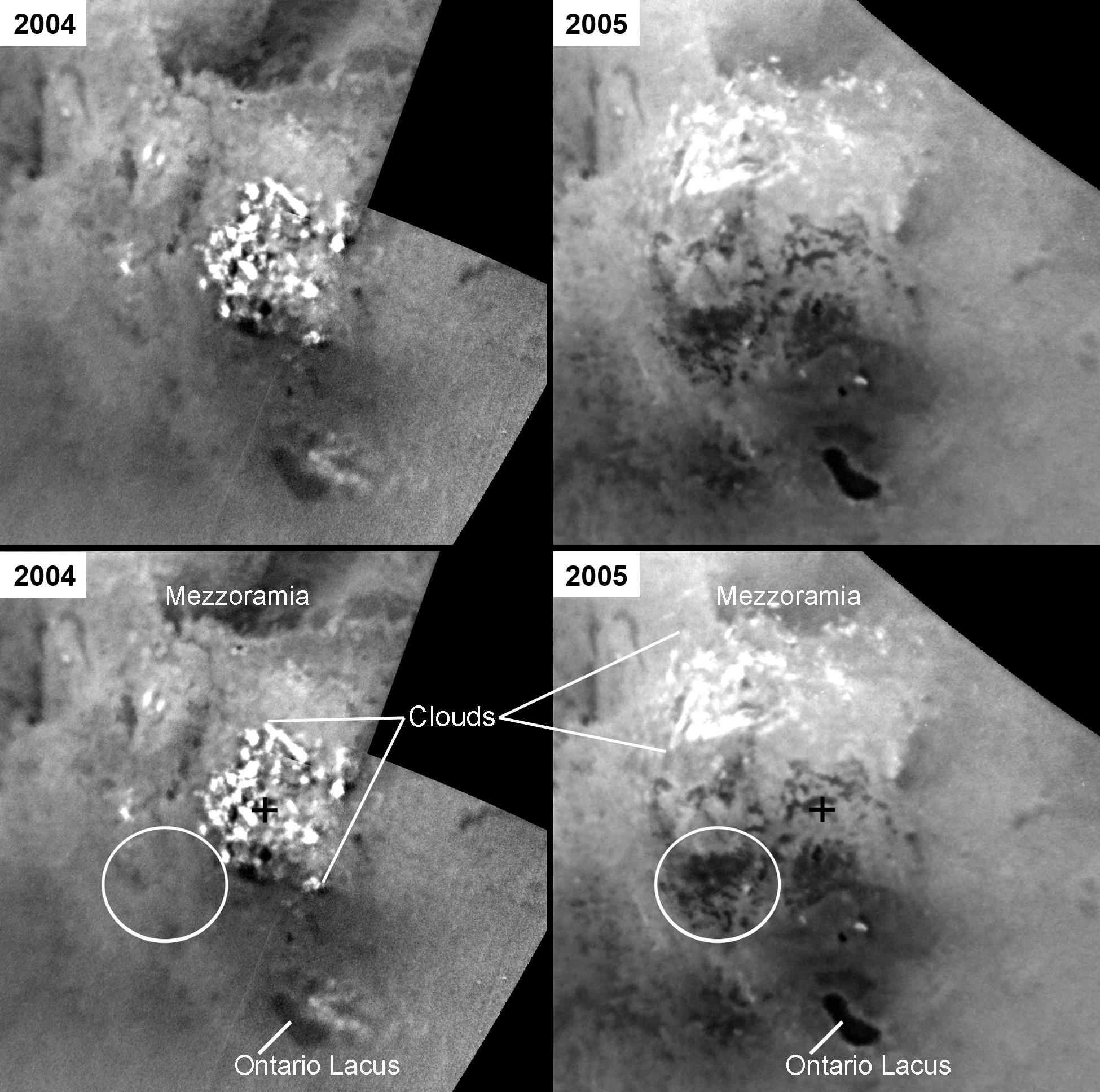
Hydrocarbon rains...
may fill lakes on Titan, the largest moon orbiting Saturn. The Cassini team has released this statement that describes seasonal changes taking place near the south pole of the body. Follow this link to see the imagery that supports the conclusion that methane rain seasonally fills these intermittent lakes with liquid methane.
Instead of a water cycle it's a hydrocarbon cycle. Just don't smoke if you visit Titan.
Instead of a water cycle it's a hydrocarbon cycle. Just don't smoke if you visit Titan.
Subscribe to:
Posts (Atom)