
2005 YU55 will zip past Earth at 3:28 pm PST today, well within the orbit of the Moon. There's no chance of an impact on either body, and here's a good NASA video that explains the close encounter.
I think we have more to fear from defunct and out-of-control satellites falling from orbit, considering the recent re-entries of UARS and ROSAT.
Showing posts with label asteroid. Show all posts
Showing posts with label asteroid. Show all posts
Tuesday, November 8, 2011


Saturday, October 22, 2011
Friday, September 30, 2011
Sleep easier tonight...
knowing that there are 44% fewer potentially threatening asteroids near Earth than previously estimated: Mid-size Asteroids Not As Big Of A Threat.
Wednesday, August 3, 2011
The second-most massive asteroid...
seen up close and personal (click image to enlarge to full resolution):
 The press release accompanying this picture indicates that "NASA's Dawn spacecraft obtained this image of the giant asteroid Vesta with its framing camera on July 24, 2011. It was taken from a distance of about 3,200 miles (5,200 kilometers). Dawn entered orbit around Vesta on July 15, and will spend a year orbiting the body. After that, the next stop on its itinerary will be an encounter with the dwarf planet Ceres."
More images and information about the ongoing mission to the asteroid belt can be found here.

More images and information about the ongoing mission to the asteroid belt can be found here.
Thursday, July 14, 2011
NASA's Dawn spacecraft...
is about to enter orbit around Vesta, the second largest but brightest object in the asteroid belt, at 10 pm PDT tomorrow evening. Here's the mission's web page.
Saturday, February 12, 2011
Wednesday, February 9, 2011
More than 100...
potentially hazardous asteroids have been added to the catalog during the last year, bring the total number to 1,197 (at the time of this post). The known list numbered 1,017 in early 2009, and 1,093 in 2010.
Spaceweather.com reports today that:
And remember this close shave, just days ago.
It's becoming a shooting gallery out there.
Spaceweather.com reports today that:
"Newly-discovered asteroid 2011 CA7 is flying past Earth today only 63,000 miles away, or 1/4th the distance to the Moon. At closest approach around 1700 UT on Feb. 9th, the VW-Bug-sized space rock will zip through the constellation Orion glowing like a 17th magnitude star."
And remember this close shave, just days ago.
It's becoming a shooting gallery out there.
Saturday, February 5, 2011
A very close shave...
occurred yesterday between asteroid 2011 CQ1 and Earth. Although the rocky object was just over 1 meter in diameter it grazed by the mid-Pacific within 5,500 kilometers, making it "the closest non-impacting object in our asteroid catalog to date."
Monday, June 14, 2010
Japanese asteroid probe...
makes historic return to Earth after its seven year mission. Here's the Hyabusa mission home page and a link to a video showing the reentry.
UPDATE: The sample return capsule has been recovered.
UPDATE: The sample return capsule has been recovered.
Wednesday, April 7, 2010
Sunday, February 21, 2010
Thursday, January 21, 2010
Saturday, November 7, 2009
Near earth object 2009 VA...
(a small asteroid) zipped by Earth yesterday ~14,000 km from the surface, well within the orbits of geosynchronous satellites. Here's the scoop from Spaceweather.com:
"If it had hit, the ~6-meter wide space rock would have disintegrated in the atmosphere as a spectacular fireball, causing no significant damage to the ground. 2009 VA was discovered just 15 hours before closest approach by astronomers working at the Catalina Sky Survey."Close shave.
Sunday, October 18, 2009
Not Chicxulub, but Shiva...
killed the dinosaurs during the KT event, according to a new hypothesis. Link to technical abstract.
And I thought it was due to smoking. I need to make a better effort to keep up with the current literature.
And I thought it was due to smoking. I need to make a better effort to keep up with the current literature.
Thursday, October 8, 2009
Dodged that bullet...
it seems: asteroid Apophis' trajectory refined. Here's the bottom line:
"Updated computational techniques and newly available data indicate the probability of an Earth encounter on April 13, 2036, for Apophis has dropped from one-in-45,000 to about four-in-a million."That doesn't mean we can't party like it's 2012, at the end of the Mayan Long Count calendar.
Wednesday, August 12, 2009
NASA is failing...
at its mission in cataloging dangerous asteroids due to lack of funding, so concludes a National Academy of Sciences interim report: Near-Earth Object Surveys and Hazard Mitigation Strategies (.pdf file.)
Indeed, on 21 January 2009 there were 1,017 potentially hazardous asteroids identified, while today, nearly seven months later, there are now 1,067.
Indeed, on 21 January 2009 there were 1,017 potentially hazardous asteroids identified, while today, nearly seven months later, there are now 1,067.
Impact craters on Earth...
as cataloged in a terrific image gallery. It's far from an exhaustive treatment, but it is a nice look at a few of the resultant landforms.
Monday, August 10, 2009
Dissipating impact scar...
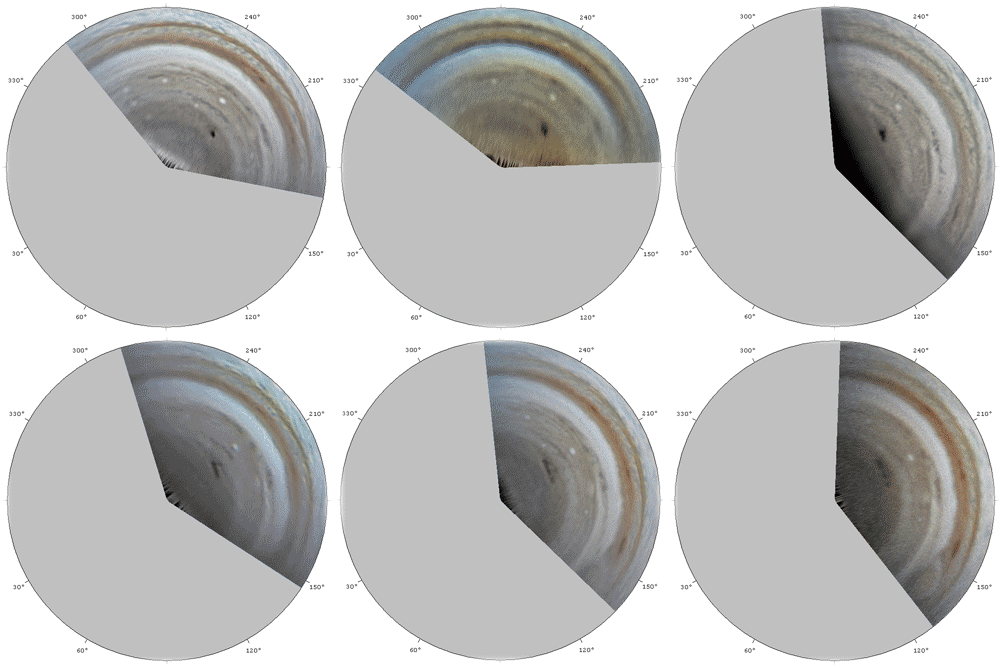 near the south polar region of Jupiter, presented as a time lapse move spanning the last three weeks. The impact site is marked by the black smudge, just to the upper right of center. A series of still images have been converted to polar projection and stitched together by clever amateur astronomers, and presented courtesy of Spaceweather.com.
Related previous post.
Monday, August 3, 2009
Asteroid Watch...
is a new web site operated by JPL/NASA to provide a centralized resource for information on near-Earth objects. To kick things off, here are the top ten asteroid facts posted on the site.
UPDATE: Check out this disturbing technical note and the related abstract.
UPDATE: Check out this disturbing technical note and the related abstract.
Thursday, May 7, 2009
When comets attack...
you better watch out, especially if the "Tunguska event" of 1908 is any indication. Here's a new twist to the long accepted idea that a fragment of a comet or asteroid exploded in the atmosphere over Siberia, leveling ~ 800 square-miles of forests, in what was the largest non-nuclear explosion in recent history.
Hint: a big part of the object still exists. Guess where it is?
Hint: a big part of the object still exists. Guess where it is?
Subscribe to:
Posts (Atom)

