Showing posts with label zegrahm. Show all posts
Wednesday, October 9, 2013
After 21 hours...
of continuous travel - from Spokane to Seattle to Los Angeles to Lima, Peru and finally to Quito, Ecuador - I have finally settled in and met with other Zegrahm staff as we plan our tour of this sprawling city at 9,400 ft above sea level. The magnificent snow and ice-covered Cotopaxi stratovolcano looms in the distance; fingers crossed for an eruption!
Friday, October 4, 2013
It will be southern hemisphere springtime...
when I explore the west coast of South America on this upcoming Zegrahm expedition. (I am on personal leave from the university the next three weeks.) Here's a map showing the itinerary of the voyage where I will work as the geologist lecturer and guide, as well as expedition photographer and Zodiac driver (click to enlarge):
Click the link above to see the detailed itinerary and meet the other staff members for this amazing travel experience.
Thursday, October 3, 2013
Here are the field reports...
for my two summer expeditions with Zegrahm (see previous post) in .pdf format:
Wild Alaska and the Bering Sea
Best of the Russian Far East
Enjoy!
Wild Alaska and the Bering Sea
Best of the Russian Far East
Enjoy!
Wednesday, July 10, 2013
For nearly the next five weeks...
I will be traveling once again with Zegrahm Expeditions as their full service geology lecturer, hiking guide, Zodiac driver and photographer, following the routes depicted in the maps below (click on images to enlarge). I'll do my best to post a pic or two every day or so, as time and conditions allow.
Piles of gear are organized and ready to stuff into a huge duffel, and I just confirmed my flights into Anchorage. There's been a little drama in obtaining my Russian visa, but it will be released today from the consulate in Seattle and Fedexed overnight to the hotel in Anchorage.
UPDATE: Whew! Fedex tracking shows my passport will arrive at the hotel before me. Close.
Piles of gear are organized and ready to stuff into a huge duffel, and I just confirmed my flights into Anchorage. There's been a little drama in obtaining my Russian visa, but it will be released today from the consulate in Seattle and Fedexed overnight to the hotel in Anchorage.
UPDATE: Whew! Fedex tracking shows my passport will arrive at the hotel before me. Close.
Sunday, May 20, 2012
I am now sipping...
a delightful Portuguese red wine in Lisbon after a relentless voyage for nearly a month at sea. I am sorry I wasn't able to make more timely posts along the way, but will make it a priority to back-post daily entries after my head hits my pillow in the States. I have an early hop to Heathrow tomorrow morning, and then a long flight to Dallas, then another hop to Grand Junction, Colorado still to come.
Stay tuned. It was a fantastic adventure to countless volcanic islands, including great geology, terrific travel companions and wonderful cultural experiences, that will all be highlighted in the days ahead. As enjoyable as it was, it was still a lot of work with lectures, zodiac driving, herding people and occasionally catching up on sleep.
Okay. One more glass and then I'm turning in. Gotta make that flight in the morning.
Stay tuned. It was a fantastic adventure to countless volcanic islands, including great geology, terrific travel companions and wonderful cultural experiences, that will all be highlighted in the days ahead. As enjoyable as it was, it was still a lot of work with lectures, zodiac driving, herding people and occasionally catching up on sleep.
Okay. One more glass and then I'm turning in. Gotta make that flight in the morning.
Tuesday, May 1, 2012
The largest volcano in the Atlantic...
is Pico del Teide, rising to a 12,198 ft (3,718 m)-high summit, on the island of Tenerife. It's the third largest volcano in the world (when measured from its base on the sea floor), following Mauna Kea and Mauna Loa in Hawaii. Here's the spectacular view as we emerged from the mist (click images to enlarge):
Pyroclastic deposits reflecting its recent eruptive history are well-displayed in a road cut near the viewpoint for the image above:
A small group of hardy walkers joined me for a several mile-long hike at about 7,000 ft in elevation that looped around the Roques de Garcia, a volcanic dike, and then dropped down onto the floor of the Caldera Las Cañadas:
Later in he day we descended the north side of the island to Puerto de la Cruz for lunch, followed by a walk through the magnificent botanical gardens:
We rounded out our full day with a quick visit to the historic village of La Oratava, where I snapped this flock of pigeons in flight:
Later in he day we descended the north side of the island to Puerto de la Cruz for lunch, followed by a walk through the magnificent botanical gardens:
We rounded out our full day with a quick visit to the historic village of La Oratava, where I snapped this flock of pigeons in flight:
Labels:
macaronesia,
travel,
zegrahm
Monday, April 30, 2012
Prior to our arrival at La Palma...
we chugged past El Hierro early in the morning, where months before there was an ongoing submarine eruption. Its activity has since subsided and there was no floating pumice seen from the ship, but the nautical chart for the area had this added notification recently pasted in the lower-left (click images to enlarge):
La Palma is the northwestern-most island in the Canary archipelago, and its volcanic origin is easily seen on the east coast where a cinder cone is being eroded by wave action:
A large number of our group made the short hike along the rim of another cinder cone on the southern tip of the island, near the Teneguia vent that last erupted in 1971:
This volcanic bomb landed on the rim of the cone, and that's RP (a marine biologist and part of the Zegrahm staff) standing next to it for scale:
After our volcanic explorations, we headed to a local bodega and eagerly participated in a wine tasting and tour of the winery:
Finally, our day was rounded out with a tour of a local pottery artisan's shop:
La Palma is the northwestern-most island in the Canary archipelago, and its volcanic origin is easily seen on the east coast where a cinder cone is being eroded by wave action:
A large number of our group made the short hike along the rim of another cinder cone on the southern tip of the island, near the Teneguia vent that last erupted in 1971:
This volcanic bomb landed on the rim of the cone, and that's RP (a marine biologist and part of the Zegrahm staff) standing next to it for scale:
After our volcanic explorations, we headed to a local bodega and eagerly participated in a wine tasting and tour of the winery:
Finally, our day was rounded out with a tour of a local pottery artisan's shop:
Labels:
macaronesia,
travel,
zegrahm
Sunday, April 29, 2012
For two days we fight...
the southward directed Canary Current, driven by the trade winds off the Azores High, as we push north to the Canary Island group. During these long days I like to spend time on the bridge, and here's a snap of the nautical chart at nearly the midway point (click images to enlarge):
A number of lectures were presented on board these two long days at sea, including mine on hot spot volcanism with a preview of the island geology to come. During a mid-day break, a chocolate dessert party was held, and here, JF, one of the Zegrahm staff, reacts joyfully to the sweets:
During the second full day at sea there were several more lectures and, JM, another staff member, conducts a wine tasting seminar in the lounge:
Several pilot whales and dolphins were sighted during our long push north, but they were fleeting encounters and I didn't have my camera at the ready to capture their playful behavior off the bow of the ship. Tomorrow we make our first landfall in the Canary archipelago!
During the second full day at sea there were several more lectures and, JM, another staff member, conducts a wine tasting seminar in the lounge:
Several pilot whales and dolphins were sighted during our long push north, but they were fleeting encounters and I didn't have my camera at the ready to capture their playful behavior off the bow of the ship. Tomorrow we make our first landfall in the Canary archipelago!
Labels:
macaronesia,
travel,
zegrahm
Friday, April 27, 2012
São Vicente Island...
provided a great opportunity to examine the volcanic geology of the Cape Verde archipelago. We used a local guide and driver to transport us to about 2,000 ft on Mt. Verde where our small group enjoyed a nice view of Porto Grande, a collapsed caldera that is used as the harbor where the Clipper Odyssey is moored for the day (click images to enlarge):
We hiked down the narrow cobblestone road for several miles, examining outcrops of ash flow tuffs along the way, with our driver collecting us near the bottom:
On the way to lunch in Bahia das Gates, the northeastern rocky coast with bright sandy beaches - comprised of sand blown in from the Sahara - dominated our attention:
My lunch with a locally brewed beer was quite delicious after our walk (even the fish head):
After exploring the town of Mindelo for several hours, we depart the Cape Verde group and are setting a northerly course for the Canaries.
We hiked down the narrow cobblestone road for several miles, examining outcrops of ash flow tuffs along the way, with our driver collecting us near the bottom:
On the way to lunch in Bahia das Gates, the northeastern rocky coast with bright sandy beaches - comprised of sand blown in from the Sahara - dominated our attention:
My lunch with a locally brewed beer was quite delicious after our walk (even the fish head):
After exploring the town of Mindelo for several hours, we depart the Cape Verde group and are setting a northerly course for the Canaries.
Labels:
macaronesia,
travel,
zegrahm
Thursday, April 26, 2012
São Tiago Island...
greets us in the morning as we arrive in the Cape Verde islands, and in this location Charles Darwin spent some time in 1831 and 1836 on his famous voyage around the world (click images to enlarge):
After we were cleared by customs officials we set off for the central market in the port town of Praia, finding it filled with friendly female vendors, and these three ladies were particularly proud of their clever stacking of bananas:
This island, the largest in the Cape Verde chain, is crowned by Antonia Peak which rises to 4,500 feet above sea level (seen in the distance). The basaltic geology in the foreground reminded me of eastern Washington:
On the way to the Botanical Gardens and Horticultural Institute we encountered school children playing a game of tag, and I was captivated by the time-intensive beadwork in their hair:
Here's a splash of color on display in the botanical garden:
And I managed to get a good shot of the colorful national bird, the gray-headed kingfisher:
After we were cleared by customs officials we set off for the central market in the port town of Praia, finding it filled with friendly female vendors, and these three ladies were particularly proud of their clever stacking of bananas:
This island, the largest in the Cape Verde chain, is crowned by Antonia Peak which rises to 4,500 feet above sea level (seen in the distance). The basaltic geology in the foreground reminded me of eastern Washington:
On the way to the Botanical Gardens and Horticultural Institute we encountered school children playing a game of tag, and I was captivated by the time-intensive beadwork in their hair:
Here's a splash of color on display in the botanical garden:
And I managed to get a good shot of the colorful national bird, the gray-headed kingfisher:
Labels:
macaronesia,
travel,
zegrahm
Wednesday, April 25, 2012
The day at sea...
today provides an opportunity to settle in to my private cabin, which doubles as my home office for the next month (click images to enlarge):
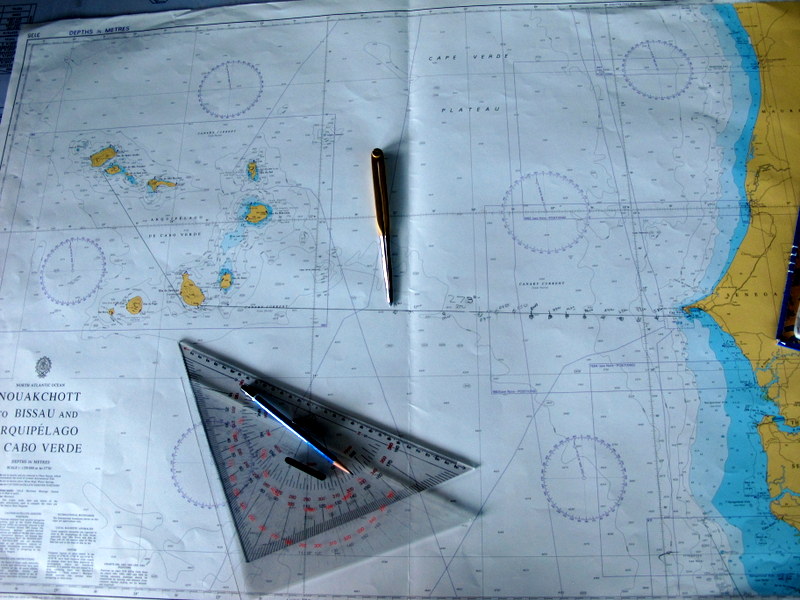
A visit to the bridge at noon shows our position about midway to the Cape Verde archipelago, our destination for tomorrow's explorations:
Several lectures were presented by expedition staff, and here our ornithologist talks about bird migration:
Late in the day the expedition leader briefs the guests on the next day's itinerary:
And lastly, it is traditional that during the first evening at sea the captain will host a cocktail party and introduce the ship's officers:
A visit to the bridge at noon shows our position about midway to the Cape Verde archipelago, our destination for tomorrow's explorations:
Several lectures were presented by expedition staff, and here our ornithologist talks about bird migration:
Late in the day the expedition leader briefs the guests on the next day's itinerary:
And lastly, it is traditional that during the first evening at sea the captain will host a cocktail party and introduce the ship's officers:
Labels:
macaronesia,
travel,
zegrahm
Tuesday, April 24, 2012
Africa's westernmost city...
is Dakar, Senegal, and it is illustrative of the expression "TIA" or "This is Africa." The euphemism is a way of lowering expectations when visiting the ethnically and culturally rich continent, where the old and modern are juxtaposed, and much of the infrastructure and many national political systems are broken. Here's just a slice of life in the capital city showing a typical street vendor (click images to enlarge):
The public transportation system looks adventurous:
But I'd prefer to avoid the raw sewage spilling into the city streets:
We headed out for a morning tour of infamous Gorée Island, now a World Heritage Site. From the 15th – 19th centuries Gorée was a slave-trading center, and we toured dungeon-like slave quarters where a monument provides testimony to the wretched history of this place:
Here's a look inside the dreary House of Slaves:
And a look at the interior of the fortified Le Castel, now a museum:
On the ferry ride back to Dakar, we witnessed local fishermen working the waters around Gorée
Island:
Late in the day we board the Clipper Odyssey seen here docked next to a US Navy frigate:
Shortly thereafter we head west, into the Atlantic, with the Dakar skyline diminishing in the distance:
The public transportation system looks adventurous:
But I'd prefer to avoid the raw sewage spilling into the city streets:
We headed out for a morning tour of infamous Gorée Island, now a World Heritage Site. From the 15th – 19th centuries Gorée was a slave-trading center, and we toured dungeon-like slave quarters where a monument provides testimony to the wretched history of this place:
Here's a look inside the dreary House of Slaves:
And a look at the interior of the fortified Le Castel, now a museum:
Late in the day we board the Clipper Odyssey seen here docked next to a US Navy frigate:
Subscribe to:
Posts (Atom)