Thursday, August 5, 2010

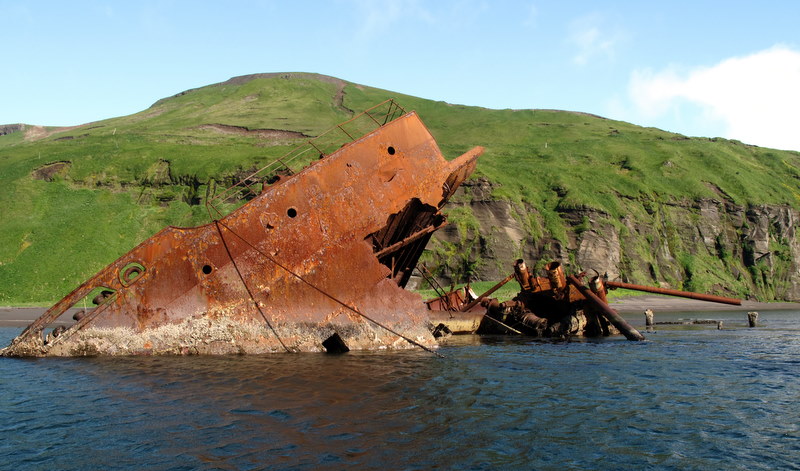
War relicts at Kiska...

include this sunken Japanese supply ship:
This electric mini-sub was destroyed while it sat in dry dock:


Kiska Island...

was occupied by Japanese forces in World War II, but they retreated in advance of U.S. bombing raids. A beautiful sunrise greeted our arrival as some of the staff headed ashore for a reconnaissance:
I was fascinated by the cross-bedded volcaniclastic deposits in the sea cliffs, likely the result of a nuee ardente:
We led small groups of curious passengers through some of the Japanese fortifications, and here's a bunker that received a direct hit by a U.S. bomb:
The black sand beaches are exquisite, but the ripped up tundra has been slow to recover from the numerous bombing raids:

Wednesday, August 4, 2010

Great Sitkin Island...

rises abruptly from the Bering Sea and provided a scenic view as we departed Adak harbor. It last erupted in 1974.
And, yes, the sun does shine (now and then) in the Aleutians. Here's my shadow as proof:
And here's a shot of Kanaga volcano - occasionally spurting some steam - off the port side of the ship as we continue our journey along this volcanic archipelago:

Adak Station...

was built by U.S. forces to confront the Japanese invasion of the outer Aleutian Islands of Kiska and Attu in 1943. Today it is a ghost base, but there are still many reminders of the various groups who served time in this remote outpost:

The last remaining personnel were removed from the base in 1997, abandoning various top secret signals intelligence and listening posts that were used during the Cold War:
The island has been returned to about 300 native Aleuts, but there are cautionary signs everywhere:
This one is especially disconcerting:

One interesting note about this visit: a 6.4 magnitude earthquake occurred here just a handful of hours before our arrival. Dang.

Tuesday, August 3, 2010

Basaltic sea cliffs...

on Saint Paul Island provide abundant ledges for a variety of shorebirds, a situation referred to as "favorable geology" by the birders on this adventure:
Here are a couple of clownish tufted puffins:
And a crested auklet:
And let's not forget these two parakeet auklets:

Monday, August 2, 2010

Saint Paul Island in the Pribilofs...

is home to a small community of Aleut natives, with a volcanic cinder cone looming over the tiny village (with last eruptions about 3,200 years ago):
This island is also home to hundreds of thousands of fur seals, and here's a male and his harem and some pups:
Two young male fur seals are sparring:
While this fur seal relaxes in the grass:

Sunday, August 1, 2010

Saint George Island...

rises abruptly from the Bering Sea, and is the southernmost volcanic island in the Pribilof group:
There is a small community established on the island, originally founded by Russian fur seal hunters. Note the Russian Orthodox church on the left, and a number of fur seals relaxing in the tundra grass:
Here's a red-legged kittewake:
And a couple of thick-billed murres:

Saturday, July 31, 2010

The Pyramid Peak trail...

on Unalaska Island carried us into the high tundra, where mass wasting on steep slopes is occurring:
This isn't too surprising, as the soils are mostly composed of tephras from countless volcanic eruptions as this exposed profile reveals:
Here's a shot of Alaska cotton grass on the verdant tundra:

Bald eagles are a dime a dozen...

in Alaska. These two were perched along a trail, about 60 ft from my vantage point for this image.

Arriving at Unalaska Island...

as viewed from the bridge of the Clipper Odyssey:
Here's a shot of the ship's captain (left) and the harbor pilot as they bring the ship alongside the dock:


The port of Dutch Harbor is now famous, largely due to a popular television show "The Deadliest Catch."

However, historians will tell you that this outpost community was bombed by the Japanese in early June 1942 as this archival image shows:

The so-called Baby Islands...

are a cluster of volcanic cinder cones that are emergent from the sea, and now being rapidly eroded by high energy waves and tidal currents. They host a variety of shorebirds, and here some tufted puffins take to the wing as our Zodiac approaches:
I caught this oyster catcher feeding in the intertidal zone:
Here are a couple of glaucous-winged gulls, and a pelagic cormorant, enjoying a perch on the volcanic breccia:
A couple of harbor seals, a mom and her pup, showed slight curiosity as we drifted by:

Friday, July 30, 2010

Unga village was established...


by a group of Norwegians as a cod fishing community in the 1890s, and the misty conditions set an appropriate mood for the now abandoned site. We explored the remaining structures that were abandoned in the 1950s:

A majestic metasequoia fossil forest...

was visited on Unga spit this afternoon, preserved in a lahar (volcanic debris flow) that is now being eroded by the energetic coastal processes. This large log measured more than 60 feet in length and about 9 feet in diameter:
Many large stumps remain in growth position in the Miocene-age deposit. Note the size of the rock that was also transported in the lahar:
The state of preservation is amazing:
The silicified wood appeared in various colors:

In all, this is a world-class fossil locality.

Thursday, July 29, 2010

An interesting walkabout...

from Chignik Bay was undertaken this afternoon, following an aging water pipe from an alpine lake to a cannery, attracting the most intrepid hikers in group:
We rapidly ascended poorly maintained ladders, many with rotten rungs and missing nails:
The view of the village was fleeting, as we were hidden in the alders along the primitive route:
Consequently, we made a lot of noise during our trek, and for good reason:

Yes, a grizzly bear had been sighted just days before, but fortunately we returned to the ship with the same number of passengers that we left with.
Sea stacks on Aghiyuk Island...

provided a backdrop for our early morning landing, and reminded me of the Oregon Coast (click to enlarge):
This alien-looking moon jellyfish washed ashore:
And here's a shot of coastal paintbrush: