Wednesday, July 28, 2010

Bears, bears, and more bears...

were observed this morning in Geographic Harbor in Katmai National Park. The Zodiacs were in the water promptly at 8 am and off we went in search of the Alaskan brown bear (also known as a grizzly bear in the interior (Ursus arctus):
The tide was falling which provided optimal conditions for bear encounters, as they wandered from the wooded slopes and out onto the tidal flats in search of clams and mussels.
We were able to approach within 20 to 50 feet of the shore, which yielded tremendous opportunities for photography:
Here's a mother and two cubs:
This mom and her cub were startled by another bear emerging from the forest, and could have cared less about us speaking in hushed voices out in our boats:
They search for clams by smell, and once located begin digging furiously:
They'll even sit down when the digging gets tough:

This cub is finding it difficult to open the clam, and seems to solicit its mother's help:
After about three hours we head back to the ship for lunch, then plan to repeat the experience with additional explorations of Geographic Harbor later this afternoon:

Tuesday, July 27, 2010

The first full day at sea...

commenced with an early exploration of The Triplets, a series of three small islands, by Zodiac. Here you can see passengers leaving the Clipper Odyssey for their several hour long adventure:
In addition to a plethora of puffins, five fledgling bald eagles, countless cormorants and sea otters, I attempted to make the uplifted sea floor sandstones seem somewhat interesting:
Later in the afternoon we visited the town of Kodiak, and visited the oldest structure in Alaska, built more than 200 years ago. This is a historic image of the building that now houses the Baranov Museum, dusted by tephra from the 1912 explosion of Novarupta volcano on Katmai:
And here's the structure as it stands today during our visit:
Just a short distance out of town is Fort Abercrombie, a World War II outpost, where the 8-inch guns and turrets stand as a memorial to battles that were never fought:
Lastly, the "touch tank" at the Fisheries Research Center was a hit with the passengers, where they were able to handle live crabs, anemones, urchins, star fish, sea cucumbers among various marine critters:

We are now underway to Geographic Harbor at Katmai National Park. I won't reveal what's planned for tomorrow, as that would spoil the surprise.

Typical Alaskan atmospherics...

were in play on the first day of overland travel from Anchorage to Seward. This concrete Beluga whale was spotted surfacing from the pavement at a viewpoint along Turnagain Arm of Cook Inlet, but I suspect I'll see a lot more of the real deal in the days ahead (click to enlarge):
We later visited the toe of the Exit Glacier (an arm of the Harding Icefield) in Kenai Fjords National Park for a short walkabout, and striations etched into the recently exposed slate bedrock can be seen in the foreground:

The highlight of the day for most of the staff and passengers was the visit to the Alaska Sea Life Center in Seward, and I was captivated by this enormous live male sea lion, with a couple of staff members along side for scale:

Along the way I spoke briefly about the Good Friday earthquake that struck the region in 1964, killing 131 people, and there are constant reminders that coastal Alaska lays in a tsunami hazard zone:

Saturday, July 24, 2010

Sailing from Seward to Sapporo...

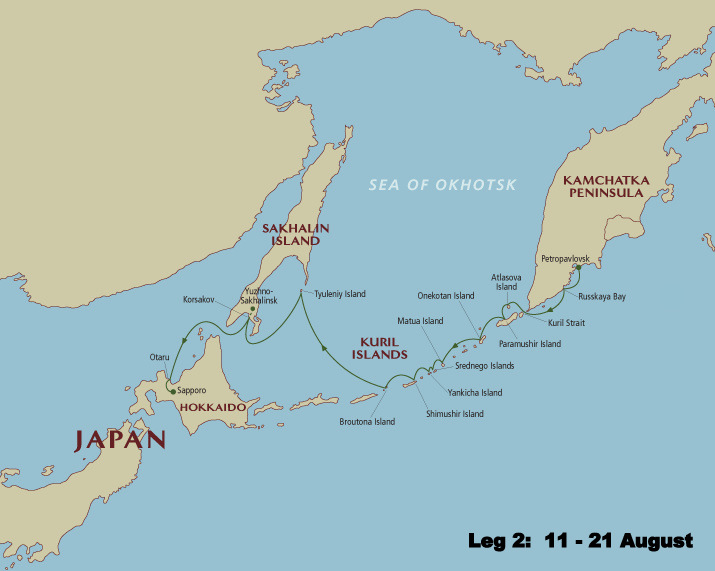
for the next month as a geology lecturer/guide with Zegrahm Expeditions. Here are a couple of maps to indicate our general route along the northern Ring of Fire:


I will blog as often as I can, posting images and tales of our adventure, so keep tuning in for the latest.

Okay, gotta go and catch the flight to Anchorage.

Friday, July 23, 2010

Perfection in the Pintler Range...

can best describe my recent dash to Montana. Forest roads from Moose Lake provided access to a trailhead into the wilderness that allowed for an extended loop hike into the high country. Here's a shot of a typical alpine scene at Phyllis Lake (click to enlarge):
I was surprised to find the quartzites polished by glacial erosion still contained well preserved sedimentary structures, and here's an excellent set of tabular-tangential crossbeds:
And some nice ripplemarks:
Here's my author/professor/ultrarunner gal pal RT casting her gaze across Johnson Lake toward a recent burn in the lodgepole pine forest:

After the ~14 mile (2,200 ft elevation gain/loss) exploration we returned to Rancho Valeo near Missoula to engage in various chores, including repairing a broken bailer (successful!), moving irrigation pipe, and tending to the needs of nine horses. Here's RT being mobbed by several of them:
All for now. Gotta pack for my next adventure to the Bering Sea. A rolling geologist gathers no moss.

Tuesday, July 20, 2010

Signs along the road...


indicating that's it's not easy being a deer in the Methow Valley.

Monday, July 19, 2010

Montana bound...

for several days, to visit with friends in Missoula and to explore the north side of the Anaconda-Pintler Wilderness. I'll post a trip report upon my return.

Sunday, July 18, 2010

Here are the highlights...

you've been waiting for from last week's field trip across Washington state (click on images to enlarge).

The first day began with a long drive across the Columbia Plateau, composed chiefly of ugly dark rocks (the Columbia River Basalt Group) that often display columnar jointing. But here we paused to examine some interesting pillow-palagonite structures:
On Day 2 we examined the fossil floras contained in the Cretaceous-age Winthrop Sandstone in the Methow Valley, where the dominantly broad-leaf specimens indicate a paleoclimate that was warmer and wetter than the present:
We then proceeded to Hart's Pass, and onto Slate Peak, the highest point one can drive in Washington. Our group had to hike the last bit due to lingering late season snow, but it provided an opportunity to closely examine the sedimentary rocks:
Here, just below the summit and nearly 7,000 ft above sea level, one can find marine gastropods in the Virginian Ridge Formation, interpreted to be a deepwater clastic environment of deposition:
Glacial geomorphology is in evidence no matter what direction you cast your gaze. This is the view north, into the Pasayten Wilderness, of a textbook example of a glacially eroded U-shaped valley:
One can believe they are visiting Switzerland and the Alps from this lofty vantage point. Jack Mountain is hidden in the clouds in the distance, and an old gold mining site lies in the foreground, in this scene to the northwest:
Alpine flowers were blooming in abundance, and this bright phlox caught my eye:
One nearby drainage burned in 2006 and provided an opportunity to examine the impact to the alpine forest ecosystem and to discuss concepts related to secondary succession:

Day 3 started with an examination of the granites associated with the Golden Horn Batholith at the highly scenic Washington Pass:
Quite by chance, I ran into an old caving buddy of mine who I hadn't seen in years. He was kind enough to take this snap of our field class:
This was followed by a short hike to Rainy Lake, a classic tarn set in a classic cirque:
Further along the North Cascades Highway (Route 20) the Skagit Gneiss is encountered, developed during the great Wrangellian crunch:
Day 4 took us to Sauk Mountain where the weather was foggy, but we still enjoyed a day filled with botany. Here's a shot of bleeding heart:
And a red columbine:
At lower elevation, later in the day, we discovered the rare parasitic Indian Pipe:
Day 5 found us ascending a snow-packed trail through the forest, beginning at Schreiber's Meadow, and delivering us at the lateral moraine below the Easton Glacier on the south flank of Mount Baker:
This scrounging Clark's Nutcracker visited us during lunch:
Day 6 provided an opportunity to rendezvous with retired emeritus professor Gene Kiver for a tour of Washington Park near Anacortes. Here we examine tide pools in the exposed mantle rocks (ophiolites):
Each water-flooded pool provided refuge for dozens of different organisms until the rhythmic return of high tide:
We spent the entire Day 7 at Double Bluff beach on South Whidbey Island, examining the interglacial deposits in the bluff and walking the sandy beach during low tide:
The mixed lacustrine and glaciofluvial sediments showed meter-scale flame structures indicative of soft-sediment deformation, likely in response to a pre-historic event on the South Whidbey fault:

And check out these two beautiful and delicate anemones:
The return drive to EWU was made the following day, via Route 2 and Steven's Pass. Great students and terrific colleagues will guarantee another summer field class next year, to a destination as yet unknown.

A puzzling collapse...

of Earth's upper atmosphere.

My new sleep system...

for summer backpacking/camping consists of the ENO DoubleNest Hammock. I slept it in every night during my field class this preceding week and found it highly restful.

It is well made and sets up quickly and easily (the straps are sold separately). It's fantastically comfortable but likely not for everyone, especially if you're not a back sleeper. Helpful hint: on chilly nights you should use a sleeping pad to provide insulation from the cold on your backside.

Friday, July 9, 2010

An east-west transect of Washington...


will be explored during a week-long field class "Scablands to Islands" that I co-teach commencing tomorrow. The mixed biology/geology course will examine the climatic and botanical variation, as well as the complex geology of numerous accreted terranes, across this impressively diverse and beautiful state. The approximate route of the excursion is indicated on the satellite image shown above (click to enlarge).

Blogging will be minimal, if at all, in the week ahead. But upon return I'll post some images and share interesting observations. OK, I've gotta get back to packing.

It's field work Friday...

on the Rathdrum Prairie in Idaho, as I make the rounds measuring groundwater levels in a select set of monitoring wells this morning. It's been more than three months since my last visit to gather data so it will be interesting to see the status of the aquifer.

Then it's back to the university for final prep and packing for a week-long field class that departs early tomorrow morning - more about that later.

The last external fuel tank...

to be manufactured, and a symbol of the end of American human spaceflight for the near future, on its way to Cape Canaveral for the last shuttle flight. Here's the press release from NASA.

Previous related post.

Wednesday, July 7, 2010

The new B-Squad Blog...

is up and running, authored by the Bu bro. It's a synopsis of his family's activities, who are now enjoying the mountain living in Aspen, Colorado for a big chunk of the summer. Take a look, people who are look takers: B-Squad Blog.

Coldest antimatter...

ever produced. And it's really, really chilly: "The team cooled down antiprotons to temperatures colder than the surface of Pluto, as low as -443 degrees F (9.26 Kelvin) -- just 17 degrees above absolute zero."

Um, cool.

Ten crazy-looking...

new deep-sea creatures. Given these, can you imagine what we'll find swimming beneath the ice encrusted ocean on Europa?

Tuesday, July 6, 2010

The life of a turtle...

This better work...

Hitting a Tiny Bull’s-Eye Miles Under the Gulf.

A very good article on directional drilling as it relates to BP's Deepwater Horizon disaster. Be sure to check out this excellent graphic.

Paper wins again...

it seems: Reading on Paper is Faster than iBooks on the iPad.

Interesting, but I don't believe the study is statistically significant. Though I do accept that there are real differences in contrast, resolution, and comfort.

Previous related post.

Testing the "standard model"...

Large Hadron Collider: Touring the Physics Frontier

Monday, July 5, 2010

Oceans of bachelor's buttons...


(Centaurea cyanus) are in bloom in the meadows among the pines in eastern Washington (click to enlarge). I can't recall seeing them this prolific in the past.

The definitive guide...

to finding free Wi-Fi.

Sunday, July 4, 2010

Today's visitors...


to my cottage in the forest in eastern Washington.

Happy Independence Day...

today, the Fourth of July, the 234th anniversary of the signing of the Declaration of Independence.

FASCINATING HISTORICAL FACTOID: "In a remarkable coincidence, both John Adams and Thomas Jefferson, the only signers of the Declaration of Independence to later serve as President of the United States, died on the same day: July 4, 1826, which was the 50th anniversary of the Declaration."

RELATED: How Fireworks Pros Make Brilliant Pyrotechnics.

Saturday, July 3, 2010

Seeing green was a real treat...

for my eyes today as I hiked trails on the south flank of Mount Spokane with friend RT. The lush forest stood in stark contrast to the red rock canyon country I had been visiting for the past 3.5 months. Retinas rejoice!
One of my subalpine favorites was pushing out the first blooms of the early summer. That's bear grass (Xerophyllum tenax), which really isn't a grass at all as it is closely related to lilies (click to enlarge):

In all, a fabulous day. Surprisingly few people for a holiday weekend. Perfect weather. Terrific company.

How to photograph...

fireworks.

I used many of the tips in the article to take this image.