Tuesday, May 4, 2010

There was more than geology...

to be seen on my circumnavigation of Upheaval Dome yesterday. Gasp! Yes, it's true. So here's a showcase of desert wildflowers in bloom (click images to enlarge).

The first is the carpet-like desert phlox (Phlox austromontana):
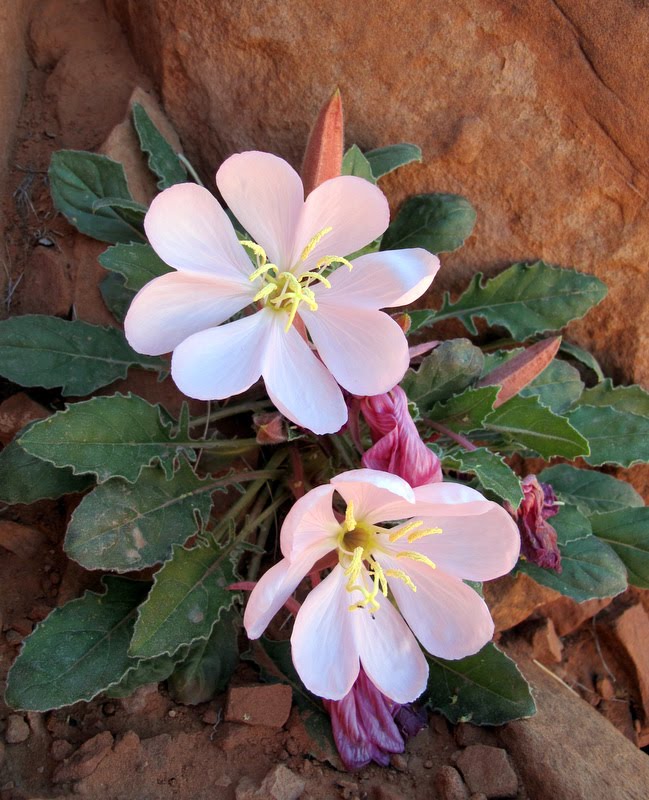
This shaded nook held a delicate dwarf evening-primrose (Oenothera caespitosa) before its petals closed in the heat of the day:
This Whipple's fishhook cactus (Sclerocactus whipplei) put on some nice blooms:
Claretcup cactus (Echinocereus triglochidiatus) is arguably my favorite cacti in all of canyon country:

This diminutive flower has a fearsome name, scorpionweed (Phacelia crenulata):
And this blue beauty is dwarf lupine (Lupinus pusillus):
Last, but not least, here's an image of spectacle-pod (Dithyrea wislizenii):

Monday, May 3, 2010

A lap around Upheaval Dome...

on the Syncline Loop Trail in the Island-in-the-Sky District of Canyonlands National Park was the objective of today's explorations (click images to enlarge). This is an arduous trail as a sign clearly warns after only a short distance from the trailhead:
There is about 1,500 feet of elevation lost/gained along the loop, and I strongly recommend following it in a clockwise direction. Here's a view into Upheaval Canyon from the steep downgrade on the west side of the structure:

Near the low point on the northwest side of the structure, a 1.5 mile spur follows a drainage and takes you into the core of the dome/crater, where strongly contorted beds of the Cutler Group are starkly revealed:
While I guzzled water and nibbled on some nuts, this foot-long female collared lizard (Crotaphytus collaris) investigated my presence in this odd place:

This trail is a geological joy and I give it my highest recommendation, but you must be fit and well acclimated, and be aware that route finding can be problematic (don't let this experience happen to you!) At no place along this trail do you get an overview of the dome/crater, so be sure to take a few minutes and visit the viewpoint. Lastly, here's a good reference (2.78 MB .pdf file) on the geology and proposed origin of this enigmatic structure.

UPDATE: I've added this vertical panoramic image of a towering water gap in the Wingate Sandstone through which the trail passes on the north side of the structure:

Moon over a monocline...


in the Moenkopi Formation on this first magnificent Monday morning in May (click to enlarge).

How many 3-D maps of the world...

can fit on a grain of salt? Answer: 1,000, and including this: "...a 25-nanometer-high topographical representation of the Swiss mountain, the Matterhorn, with a scale of 1:5 billion."

Amazing, but kinda hard to use in any practical way, though.

Sunday, May 2, 2010

Fossilized crayfish burrows on steroids...


from the Triassic Chinle Formation. This outcrop, easily located in a small canyon at milepost 13 on Utah 128, shows a dense profusion of burrow casts (click to enlarge). Note the DNAG photo scale card in the center of the image, at the mid-point of an individual burrow that's at least several meters long/deep. This morphology suggests a stable, but slowly aggrading substrate, at the time of its construction.

Here's a related post that describes my research interest in these trace fossils.

Saturday, May 1, 2010

Size XXL carbon footprint...

Al Gore, Tipper Gore snap up Montecito-area villa

The morning after...

the storms:


The scent of damp sage permeates the chilly air.

Friday, April 30, 2010

Storms rolling off the La Sals...

this evening, as seen from Castle Valley, Utah:


Active weather always adds more drama to an already breathtaking landscape.

The botanical survey of canyon country...

resumes after a series of snow squalls kept me indoors the last two days (click images to enlarge). For starters, here's spreading daisy (Erigeron divergens):
Fremont's mahonia (Mahonia fremontii) is greening nicely, smelling sweet, and busting out with yellow blossoms after a long winter:
Lastly, one of the most recognizable plants in the desert southwest is Mormon tea (Ephedra viridis), and here you can see a male plant with developing pollen cones:

Wednesday, April 28, 2010

Notice a recurring theme...

in downtown Moab, Utah?

No wonder these are running around the desert in the local area.

Get 'em while you can...

Sony To End Floppy Disk Production in 2011.

Seriously, who the heck uses these things anymore? I'm frankly eager for spinning disk data storage technology to die - it's mechanical, slow to access, and sucks battery life.

Essays from the volcanic ash...

Edge: THE ASH CLOUD

Tuesday, April 27, 2010

The sweet pungent aroma...

of Cliff Fendlerbush (Fendlera rupicola) was in the air today along the Colorado River (click to enlarge):
Really, it's too bad the computer screen isn't scratch-n-sniff capable. And let's not forget this bright yellow gem, a Western Wallflower (Erysimum asperum):

I try to carry my camera with me wherever/whenever I go, and today these beauties were caught colorfully painting the ruddy sandstone ledges along my commute to the big city (um, Moab). Enjoy.

Great blue herons...

are beginning to flock to their rookery along the Colorado River near milepost 9 on Utah 128, between Moab and Castle Valley, Utah. Here's a wide shot of several of their nests in a Gamble oak grove on the opposite side of the river (click to enlarge):
And a close-up of one of the big ladies (Ardea herodias) standing in the apical nest:
I've counted as many as a dozen nests in this cluster, and most are usually occupied by late spring based on my prior observations.

Monday, April 26, 2010

Peeling off the strata...


of the Onion Creek salt-cored anticline in this mini-pan view toward the west (click to enlarge). The highly-deformed gypsum caprock of the Pennsylvanian Paradox Formation is the light green to gray unit in the bottom of the valley, with the overlying red beds of the Cutler Formation (Early Permian) dipping off slightly to the north (right) and south (left). Those are the Fisher Towers on the skyline to the right of center.

See the post immediately below for related geo-info.

Something really stinks...

at the appropriately named Stinking Spring on Onion Creek, Utah, where both hydrologic features sit directly upon the Onion Creek salt diapir. Here's an image of the spring where it joins the creek (click to enlarge), with the contorted beds of gypsum caprock of the Paradox Formation (Pennsylvanian) in the background:
Filamentous green sulfate-reducing bacteria thrive in the hyper-saline water and can be seen here upon close examination of the spring, and they are the source of the hydrogen sulfide gas that produces the strong rotten eggs smell:

Sunday, April 25, 2010

Friday, April 23, 2010

Thursday, April 22, 2010

White-Nose Syndrome...

is unfortunately moving westward (click map to enlarge), having just been discovered in Missouri and western Tennessee, according to Bat Conservation International and other state and federal agencies:
"Since White-nose Syndrome was discovered in a single New York cave in February 2006, more than a million hibernating bats of six species have been killed by the disease in twelve states."
Follow this link to learn more about this devastating disease, and remember, bats need friends.

You don't need a telescope...

to enjoy these shows: Best Meteor Showers of 2010. Don't dawdle, the Lyrids are peaking right now.

The best is yet to come...

First Light for the Solar Dynamics Observatory

Tuesday, April 20, 2010

Amazing images from Iceland...

More from Eyjafjallajokull

Hey, what do you expect from an active divergent margin?

Monday, April 19, 2010

Rocks came tumbling down...


yesterday in Castle Valley, Utah while I was engaged in explorations elsewhere. But my quick thinking neighbor captured this mass wasting event to share with others who may have missed it.

Image credit: JW. Thanks!

Sunday, April 18, 2010

Time will tell...

Get Ready For Decades of Icelandic Fireworks

Previous related post.

"Flying Men" petroglyphs...

were the objective of this morning's hike near Moab, Utah, in the company of Geogal and Skipper. On the short walk we encountered a lovely meadow at the peak of bloom with desert wild onion (Allium macropetalum) (click to enlarge):
And blue-star (Amsonia tomentosa) was no slouch either:
We ultimately achieved our goal, finding two large boulders liberally adorned with anthropomorphic figures bearing wings:

There's even an embedded anorexic Kokopelli for the careful observer.

NOTE: The upside-down and more recently pecked "JB" (upper left on boulder) was done by a vandal, and not by your desert correspondent!

We'll have to rewrite...

geology textbooks: Extramarital Sex Fuels Earthquakes, Warns Iran Cleric. In sum:
"Many women who dress inappropriately ... cause youths to go astray, taint their chastity and incite extramarital sex in society, which increases earthquakes," Ayatollah Kazem Sedighi told worshippers at overnight prayers in Tehran.

Friday, April 16, 2010

Vistapans from Dry Mesa...

acquired during my mini-expedition yesterday to remote overlooks above the Colorado River (click to enlarge). The first shows the tortured rocks at the southern end of Cache Valley, sinking into the collapsing center of the salt-cored structure:
And here's the wide view into Ida Gulch (left) and Castle Valley (distant center):
Enjoy!

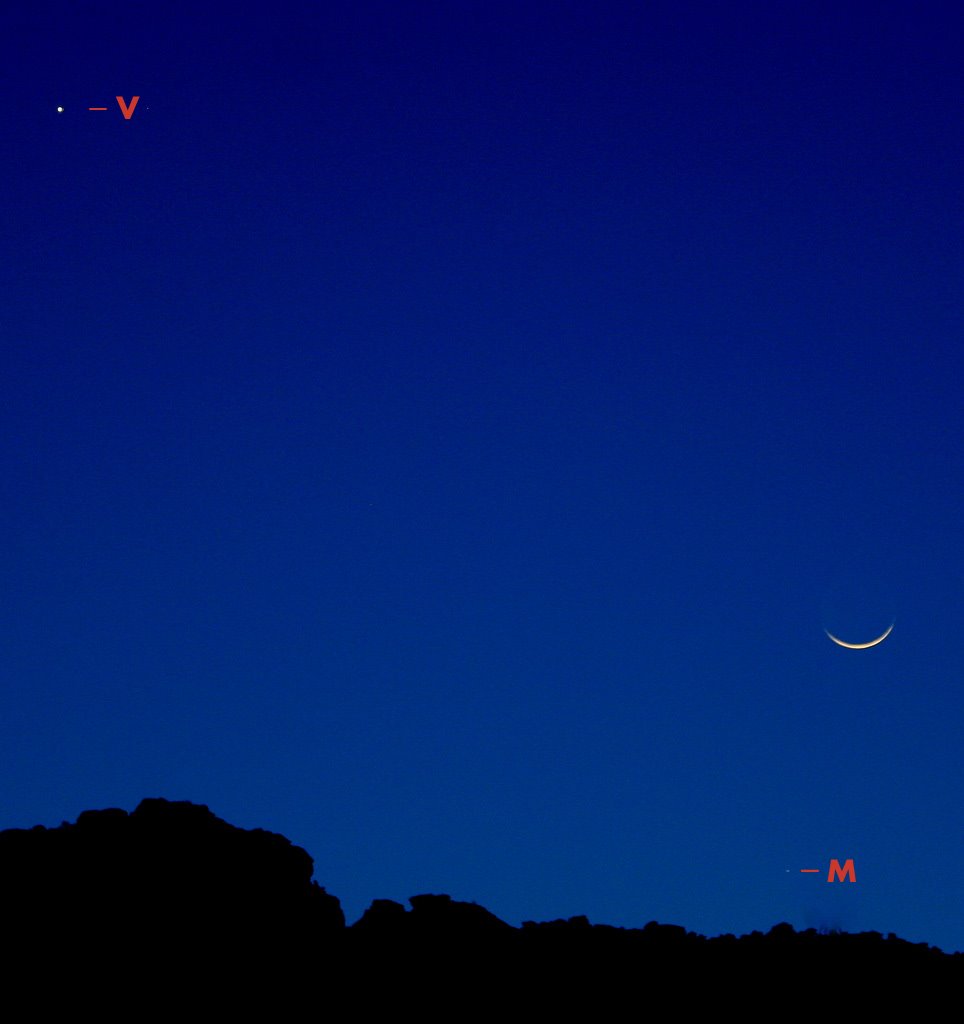
The sliver of a new Moon...

accompanied by Venus and Mercury, caught at sunset last night over Porcupine Rim (click to enlarge).

I'm siding with Neil...

Battle of the Moonwalkers.

UPDATE: The only geologist-astronaut weighs in too: Former Astronaut Blasts Obama’s Plans for Space Program.

Desert flowers were strutting their stuff...

in Cache Valley Wash in Arches National Park yesterday, and here are just a few examples (click to enlarge). First, there is the ubiquitous and diverse desert paintbrush (Castilleja chromosa):
In addition, the alkaloid-bearing woolly locoweed (Astragalus mollissimus) appeared in parts of the gravelly creek bed, and if ingested by livestock can often be lethal:
But not to be outdone, the showy Utah penstemon (Penstemon utahensis) stood erect and was adorned with bright red flowers:

Thursday, April 15, 2010

Rarely-seen views...

from the seldom-visited Dry Mesa were the highlight of my solo sojourn into this remote area adjacent to Arches National Park. In fact, it's accessed via a 4WD jeep road from the Lower Delicate Arch viewpoint in the park, and from there, by foot on faint game trails and then, by bushwhacking. (Click to enlarge images.)

Here's a shot, looking southeast, into the axis of the Onion Creek anticline. Fisher Towers are in the escarpment to the left of the down-dropped center portion of the salt-cored structure:

Here's the view looking due south, into Ida Gulch and beyond to the La Sal Mountains. Not too bad:
And into Castle Valley, another collapsed salt-cored anticline. That's Parriott Mesa to left of center, and the location of my home away from home is circled:
While relaxing on my lofty perch I enjoyed a nice lunch consisting of some jerky and the best apple ever:
To summarize this terrific day:
  • ~1,350 ft elevation gained/lost
  • ~ 7.5 mi hiked
  • 3 bighorn sheep
  • 0 people
Priceless. And, oh yeah, it's my birthday.

Watch out for jokulaups...

as a subglacial volcanic eruption in Iceland, beneath the Eyjafjallajokull glacier, produces a giant glacial outburst flood (termed a jokulaup for you non-geo readers): Iceland Volcano - Hundreds Evacuated After Eruption.

In addition, air traffic has been disrupted over the north Atlantic and northern Europe due to large amounts of volcanic ash in the atmosphere.

Trapped in amber...

since the Cretaceous: a slideshow.

Sunday, April 11, 2010

Another bellwether...


of springtime weather is Parry's biscuitroot (Lomatium parryi) in the blackbrush community in southern Utah (click to enlarge).

Saturday, April 10, 2010

Newberry's twinpod...


(Physaria newberryi) is an indicator that spring has sprung in canyon country (click to enlarge). This little gem was found blooming in Stearn's Creek this morning, in Professor Valley, Utah. Enjoy.

Oh yeah, this species is named after geologist John Strong Newberry.

Thursday, April 8, 2010

Mountain snowpack...


in the southern Rockies is well above normal, but it is pretty dismal elsewhere, especially in the Pacific Northwest (map as of 1 April 2010). In the La Sals, shown above (click to enlarge), snow depth for this time of year is running about 110 - 129 % of normal.

Project Ozma...

commences 50 years ago, in early April 1960, led by Frank Drake, in a pioneering experiment searching for extraterrestrial intelligence. This led to the now famous Drake equation:


that estimates the number (N) of intelligent civilizations in the Milky Way galaxy. (Follow the link to understand the other terms in the equation.)

Here's an earlier post about SETI's 50th anniversary.

RELATED: A similar equation has been formulated that explains why geeks lack girlfriends.