
Showing posts with label paleontology. Show all posts
Showing posts with label paleontology. Show all posts
Thursday, March 8, 2012


Monday, February 27, 2012
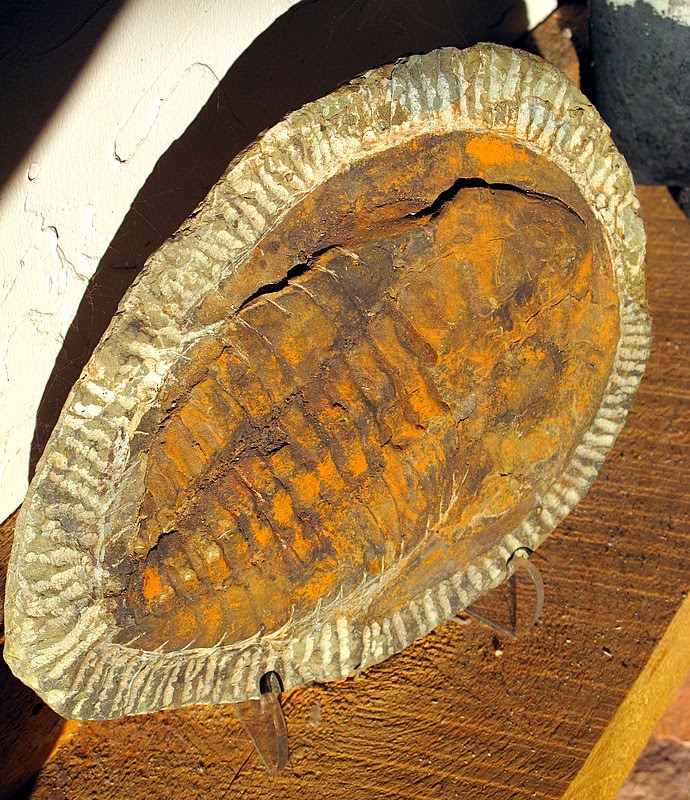
Morocco’s best known geologic export...
Wednesday, February 22, 2012
Ash-covered forest...
is a 'Permian Pompeii' according to researchers. Extraordinary preservation of a great diversity of plant fossils - an entire ecosystem of a peat-forming swamp quickly frozen in time - makes this a stunning discovery. Check out these images.
Wednesday, January 18, 2012
Geological treasures rediscovered...
in an old wooden cabinet in a "gloomy corner" of the British Geological Survey: U.K. scientists find 'lost' Darwin fossils. And here's the understatement of the day from the executive director:
"It really makes one wonder what else might be hiding in our collections."
Sunday, December 4, 2011
Tuesday, November 22, 2011

Saturday, November 19, 2011
Slow motion extinction...
at the end of the Cretaceous: Massive volcanoes, meteorite impacts delivered one-two death punch to dinosaurs.
Afterwards, mammals celebrate!
Afterwards, mammals celebrate!
Thursday, October 6, 2011
Wednesday, July 27, 2011
Saturday, May 21, 2011
49 million-year-old face...
of a spider found frozen in amber. The detail revealed by the CT scan is extraordinary, and be sure to watch the video at the linked article.
Note that the specimen is contained in Baltic amber, a region that is known for its amber resource, and that I'll be exploring in several weeks with Zegrahm Expeditions. Amber is often found in beach gravels along the southern coast of the Baltic Sea, and I'll be sure to watch for specimens during my travels.
Note that the specimen is contained in Baltic amber, a region that is known for its amber resource, and that I'll be exploring in several weeks with Zegrahm Expeditions. Amber is often found in beach gravels along the southern coast of the Baltic Sea, and I'll be sure to watch for specimens during my travels.
Tuesday, May 17, 2011
Professor Ernest Gilmour is retiring...

A reception will be held next Tuesday, 24 May, from 3-5 pm in PUB 206. Refreshments will be served and everyone is invited to attend. Contact the departmental secretary at 509/359-2286 if you have any questions.
Monday, May 16, 2011
New vertebrate paleontology course...
will be offered this coming fall term: GEOL 496/BIOL 496 - Vertebrate Life Through Time, instructed by Dr. Judd Case (4 cr). The course will meet in lecture on Tuesdays and Thursdays from noon to 1:15 pm, with lab on Monday afternoon from 2-5 pm.
Sunday, May 1, 2011
Peace River redux...
We had such an enjoyable and successful fossil hunting excursion yesterday that we decided to try our luck again by returning to the same reach of the Peace River. My niece is seen here standing amid piles of sieved and discarded gravel between previously dug holes by other fossil seekers (click to enlarge):
 Among the more interesting specimens found today are, from left to right, an alligator tooth, two juvenile megalodon teeth, a skate's pavement teeth, and a horse tooth:
 While this activity didn't quite substitute for the excitement of watching a shuttle launch, we all agreed that it was still big fun, and equally educational. And the quality time spent with my brother and his kids was, well, priceless.


Saturday, April 30, 2011
Fossil hunting on the Peace River...
near Brownville Park, Florida was the objective of the day. The stream is incised into the Oligocene to Pliocene age sedimentary rocks of the Hawthorne Group, and various fossils are transported with the bed load gravels in the warm and shallow channel (click to enlarge):
 Both marine and terrestrial fossil faunas are found by digging and sieving large volumes of sediment. That's the Bu bro on the right with my niece and nephew working the sieves:
 We were richly rewarded for the day's efforts. In the image below, clockwise from top, is a dugong rib bone, a horse tooth, a juvenile megalodon tooth, a vertebrae, a skull fragment, and in the center, an alligator osteoderm:
 My niece was particularly talented at finding dozens of tiny shark's teeth by hand-sifting the sandier sediment (but the larger megalodon tooth was found in a sieve):
 If you engage in this activity I highly recommend Florida's Fossils by Robin C. Brown. Indispensable.


Monday, April 18, 2011
Guest geology lecture...
on the paleontology and stratigraphy of the Chuckanut Formation in northwestern Washington, by Renee Breedlovestrout, is scheduled for Monday, 25 April, at noon in SCI 118. Renee will also linger a bit afterward to discuss how to apply to graduate school with interested students.
Saturday, April 9, 2011
Thursday, January 20, 2011
An interesting new film...
on the Chauvet-Pont-d'Arc Cave, by Werner Herzog, is set to release in March 2011. Here's the trailer with an overly dramatic soundtrack:
Sunday, September 26, 2010
How to fossilize yourself...
for future generations.
I've always thought that being entombed by a turbidity current in a deep (anoxic) basin would favor long-term preservation.
I've always thought that being entombed by a turbidity current in a deep (anoxic) basin would favor long-term preservation.
Thursday, September 23, 2010
Thursday, July 1, 2010

Subscribe to:
Posts (Atom)
