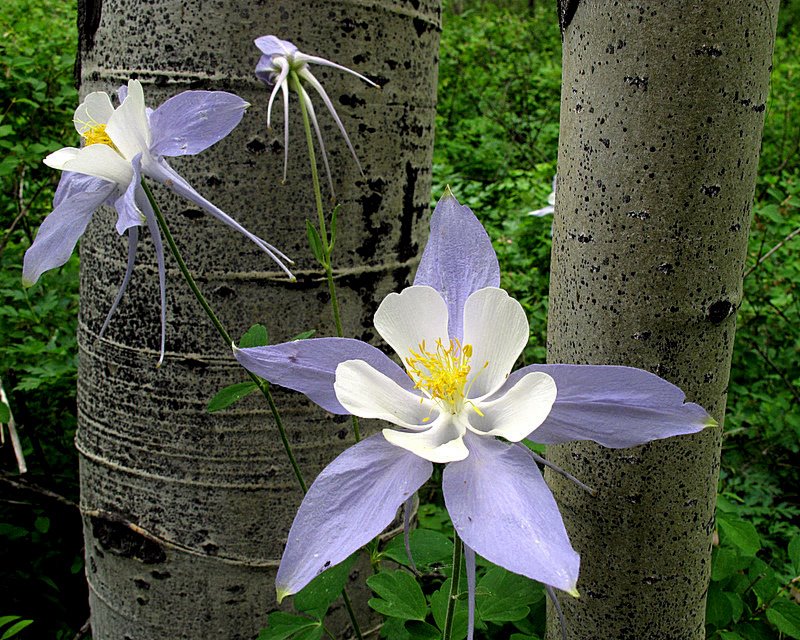
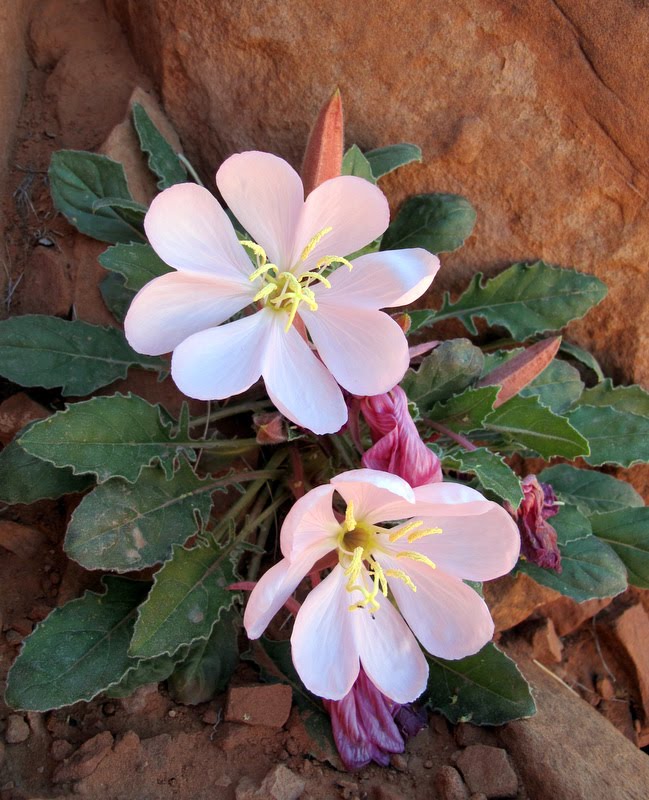
(Fendlera rupicola) fills the air with a sickly sweet odor along the Colorado River that can't be exaggerated, and here's the culprit (click images to enlarge):
This yellow beauty is Fremont's mahonia (Mahonia fremontii), but it's not nearly as pungent:
The Colorado Plateau is just beginning to show its colors this spring as the parade of flowering plants commences.
Showing posts with label botany. Show all posts
Tuesday, April 10, 2012
Wednesday, February 22, 2012
Ash-covered forest...
is a 'Permian Pompeii' according to researchers. Extraordinary preservation of a great diversity of plant fossils - an entire ecosystem of a peat-forming swamp quickly frozen in time - makes this a stunning discovery. Check out these images.
Labels:
botany,
geology,
paleontology
Tuesday, February 21, 2012
Tuesday, December 6, 2011
The Christmas cactus...
in my window is in full bloom for the holiday season (click to enlarge):
Enjoy the splash of color, and happy holidays to all.
Sunday, May 15, 2011
"Botany Washington"...
is an annual event organized by the Washington Native Plant Society, and this year it convenes this weekend in eastern Washington. I'm heading out shortly to meet a group led by EWU botanist RO'Q at Turnbull National Wildlife Refuge, in the middle of the Cheney-Palouse Scabland Tract. I'll speak about the catastrophic Pleistocene flood origin of the gravelly soils, and crawl around the ponderosa pine forest with the group for a while to see what's in bloom.
UPDATE: Some of the showier plants included western serviceberry (Amelanchier alnifolia)(click to enlarge):
Common camas (Camassia quamash):
Arrowleaf balsamroot (Balsamorhiza sagittata):
And while the biologists crawled around on their hands and knees, keying out various mini-floras, one of the native fauna caught my attention:
Labels:
botany,
geology,
washington
Monday, July 5, 2010
Oceans of bachelor's buttons...
(Centaurea cyanus) are in bloom in the meadows among the pines in eastern Washington (click to enlarge). I can't recall seeing them this prolific in the past.
Labels:
botany,
image,
washington
Saturday, July 3, 2010
Seeing green was a real treat...
for my eyes today as I hiked trails on the south flank of Mount Spokane with friend RT. The lush forest stood in stark contrast to the red rock canyon country I had been visiting for the past 3.5 months. Retinas rejoice!
Labels:
botany,
image,
personal,
washington
Saturday, June 26, 2010
When the desert gets hot...
one can find cool refuge in the high country in the La Sal Mountains where the alpine meadows are still resplendent with wildflowers (click to enlarge):
Monday, June 14, 2010
An a-mazing experience...
was had by all in the Maze District last week; that is, all the one of me. Here's the trip report from my solo excursion that starts with hitching a ride down the Colorado River from the Potash boat ramp, just downstream from Moab (click images to enlarge):


The boat pilot, a mechanic, and myself were on board for the ~ 50 mile meandering journey that took about 1.5 hours, despite a couple of hiccups with the fuel pump:
The confluence with the Green River, the main tributary to the Colorado, is rather unremarkable at river level. At nearly peak discharge during the runoff season the diffusion boundary between the two sediment laden rivers was indiscernible:

Donning life jackets as we entered upper Cataract Canyon per regulations, we arrived at Spanish Bottom just a few minutes later. This is the daunting view of the 1,200 ft high escarpment I had to climb up to the Doll House and into the Maze (yes, countless short switchbacks run up the center of the image):
So I set off alone on my trek, snapping this rare self portrait that includes free advertising for a Spokane-area geotechnical firm with whom I do some consulting:

After climbing the Doll House Trail only a short distance this was the perspective as I watched the jet boat charge upriver, with Red Lake Canyon entering in the center of the image from the Needles District on the south side of the river. That's the gypsum caprock of the Paradox Formation in a domal outcrop at river level:

And here's a broader panorama of the sunken Spanish Bottom, an enlarged graben, from higher up the steep trail. The lower, lighter colored rocks are mostly carbonates while the upper, redder strata are shales and sandstones of the Cutler Group:
Fallen blocks of limestone from the Honaker Trail Formation littered the trail and were chock full o' fragments of crinoids and brachiopods, and gave me a convenient excuse to take it slow:
After ultimately reaching the top I entered a different world, and set out to find a suitable site to establish a basecamp for my explorations in this pinnacled and complex terrain:
I never figured out which of the Cedar Mesa Sandstone outcrops was the Doll House, nevertheless I selected an east facing sheltered ledge, and here's the view from my aerie perch toward the distant La Sal Mountains:

Sunset over the Needles the first night was sublime:
The next day was devoted to a long hike out to the overlook of the Green River, passing Beehive Arch along the way:
The end of the trail yielded a seldom seen (and seldom photographed) spectacular view of the incised confluence. The Green flows towards the viewer from the left, with the confluence with the Colorado just right of center in the distance:
A telephoto shot from nearly the same vantage point confirms that the Meander anticline really does exist and the Colorado River flows along its axis. Note that the rocks dip away from the river on either side due to the removal of overburden pressures through erosion of the canyon, thereby allowing the buoyant salts of the Paradox Formation to bulge upwards:
On the return hike a bright pink prickly pear cactus (Opuntia erinacea) caught my attention, as well as that of several pollinators:
And yellow beeplant (Cleome lutea) was abundant in the meadows:
And prince's plume stood erect among the sandstone pinnacles:

Dusk yielded another exquisite view of the Needles this next night, followed by a spectacular lightning storm:
The following morning hike to the south carried me along Surprise Valley, another sunken structural graben:
The trail ultimately terminated at several well preserved granary structures in a deep alcove (a fourth one is off the image to the right):
And the silvery-green roundleaf buffaloberry (Shepherdia rotundifolia) still glistened with water droplets from the blustery late night storm:
Water and food eventually dwindled, and I returned to the river to catch the jet boat at an appointed time. Having arrived 90 mins early at Spanish Bottom I poked around the boulders examining the sedimentary structures and fossils they contained and found this cherty treasure hidden among them:
A fantastic end to a fabulous journey. In sum, adventures such as this distill the essence of life down to the very basic. I must start planning the next one with only a couple of more weeks left in canyon country this season.
Thursday, June 3, 2010
Picturesque prince's plume...
(Stanleya pinnata) is presently peaking profusely (click to enlarge). Um, sometimes these posts write themselves.
And a nearby bush encelia (Encelia frutescens) is in fine form:
Tuesday, June 1, 2010
Glorious globemallow...
(Sphaeralcea coccinea) dominates the landscape with only days to go until summer (click to enlarge). The knee-high stalks, pregnant with bright orange blossoms, look good enough to eat.
Thursday, May 27, 2010
Beautiful reproductive stalks...
standing tall and bearing numerous blossoms, the narrowleaf yucca (Yucca angustifolia) is hands down one of my favorites (click to enlarge). It also caught Ed Abbey's attention: "Despite its fierce defenses, or perhaps because of them, the yucca is as beautiful as it is strange."
And that's Parriott Mesa looming in the background (click to enlarge). Yeah, another lousy day in Utah.
Wednesday, May 26, 2010
Rough mule's ear...
(Wyethia scabra) illuminated by the glow of the setting sun (click to enlarge). I grabbed this shot on the way into the valley last night.
Sunday, May 16, 2010
Another bloomin' sunflower...
is approaching its peak, where this time it's the Hopi blanketflower (Gaillardia pinnatifida). Here's an image from my late morning hike:
Tamarisk in bloom...
is certainly a lovely sight, however, this non-native and highly invasive plant is the bane of the riparian southwest. Several years ago tamarisk leaf-eating beetles were introduced along the Colorado River around Moab, Utah, and as their name suggests, they've been chomping on the shrub quite aggressively. Most plants look pretty stressed right now, but some can still manage the energy to push out some blossoms (click to enlarge).
So, time for assessment of the project has arrived, as announced recently in the local paper: County study to analyze local impact of tamarisk beetles. And here's the link to the USGS publication referenced in the article above: Saltcedar and Russian Olive Control Demonstration Act Science Assessment.
Sunday, May 9, 2010
Tuesday, May 4, 2010
There was more than geology...
to be seen on my circumnavigation of Upheaval Dome yesterday. Gasp! Yes, it's true. So here's a showcase of desert wildflowers in bloom (click images to enlarge).
The first is the carpet-like desert phlox (Phlox austromontana):
This shaded nook held a delicate dwarf evening-primrose (Oenothera caespitosa) before its petals closed in the heat of the day:
This Whipple's fishhook cactus (Sclerocactus whipplei) put on some nice blooms:
Claretcup cactus (Echinocereus triglochidiatus) is arguably my favorite cacti in all of canyon country:
This diminutive flower has a fearsome name, scorpionweed (Phacelia crenulata):
And this blue beauty is dwarf lupine (Lupinus pusillus):
Last, but not least, here's an image of spectacle-pod (Dithyrea wislizenii):
Subscribe to:
Posts (Atom)