Showing posts with label astronomy. Show all posts
Showing posts with label astronomy. Show all posts
Wednesday, April 18, 2012


Monday, April 9, 2012
Just like Stellar Cartography...
in Star Trek: This Astronomy App Totally Justifies the Cost of a Surface Table. Awesome.
I'm hoping they'll port this to tablets because I really can't justify buying the 40-inch Surface, as cool as it is.
I'm hoping they'll port this to tablets because I really can't justify buying the 40-inch Surface, as cool as it is.
Tuesday, March 20, 2012
Spring has sprung...
in the northern hemisphere, with day and night being equal length today on the vernal equinox. Warmer and longer days are ahead. Oh, the joy!
UPDATE: There are two inches of snow on the back deck this morning. Sheesh. Some spring.
UPDATE: There are two inches of snow on the back deck this morning. Sheesh. Some spring.
Tuesday, March 13, 2012
The conjunction of Jupiter and Venus...
in the western night sky this evening, captured at around 8 pm PDT, shows the bright planets seemingly side-by-side (click to enlarge):
 Their relative orientation will change quickly this week, so keep watching if the weather provides clear skies.

Monday, March 12, 2012

Saturday, March 3, 2012
Mars is at opposition...
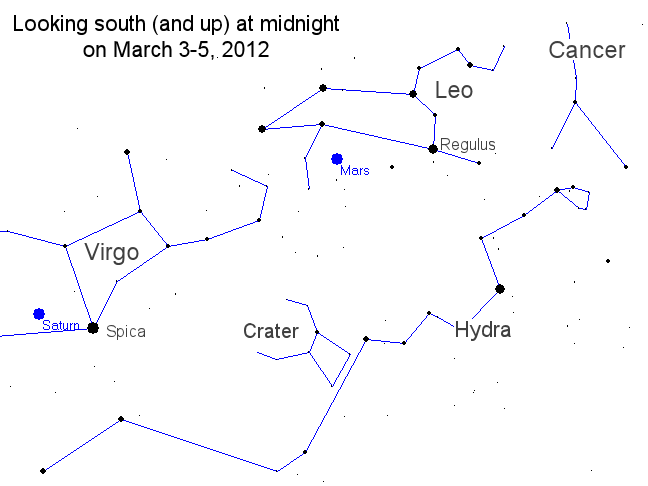
this weekend, meaning that the Earth and the red planet are in alignment on the same side of the Sun, and it's also the closet the two planets will approach each other in 2012. Here's a map view of the solar system showing the positions of all the planets, and a sky map if you want to go out around midnight and locate it in the night sky. Look toward the south and up, and it'll be the bright red object in Leo. (Here's a more advanced sky map if you want to track the motion of Mars over the next few months and into late summer.)
NOTE: Just a little east of Mars, Saturn will be glowing bright yellow in Virgo, very near the hot white-blue star Spica.
NOTE: Just a little east of Mars, Saturn will be glowing bright yellow in Virgo, very near the hot white-blue star Spica.
Wednesday, February 29, 2012
Use today judiciously...
Wednesday, February 22, 2012
Upcoming planetary alignments...
promise to be cold and spellbinding. Bundle up and head outside in the early evening to observe Jupiter, Venus and Luna in various geometries, both later this weekend and in mid-March. A telescope isn't needed to enjoy the show, and there are several sky maps at the link to help you identify what's what. (Here's more information.)
I'll certainly be out and gazing skyward, and hoping it's clear.
I'll certainly be out and gazing skyward, and hoping it's clear.
Tuesday, February 14, 2012
The Rosette Nebula...
seems like an appropriate astroimage to share on Valentine's Day (click to enlarge):
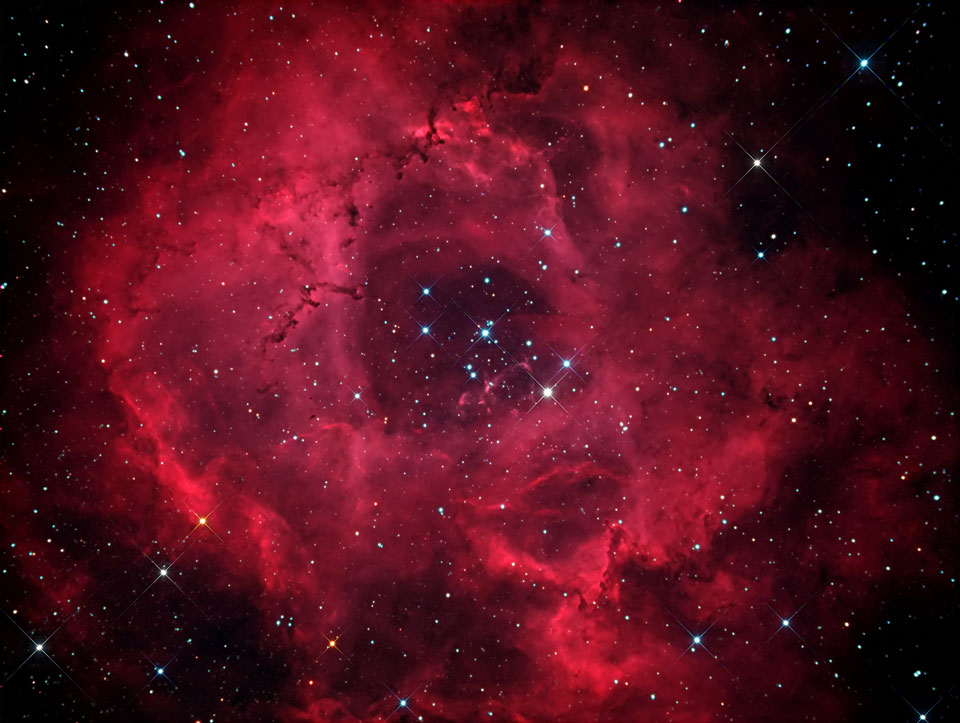 Image credit and copyright: Brian Davis, via APOD.
Thursday, February 2, 2012
Groundhog Day...
falls on a cross-quarter date, midway between the winter solstice and the spring equinox. (May Day and Halloween are two others.) So regardless of what the the famous Pennsylvania rodent sees, it's still six weeks to the first day of spring in the northern hemisphere.
Breaking news: The buck-toothed Punxsutawney Phil did see his shadow early this morning, signaling six more weeks of winter. Big surprise.
Breaking news: The buck-toothed Punxsutawney Phil did see his shadow early this morning, signaling six more weeks of winter. Big surprise.
Monday, December 26, 2011

Wednesday, December 21, 2011
The longest and shortest...
night and day, respectively, occurs today/tomorrow (depending on your time zone), known as the winter solstice. Although this marks the beginning of winter in the northern hemisphere, it also means that daylight hours will begin to gradually lengthen.
And the apocalypse countdown commences. Enjoy the next 365 days - they're all you've got.
And the apocalypse countdown commences. Enjoy the next 365 days - they're all you've got.
Saturday, December 10, 2011
I get up early...
so you don't have to, and here's the fruit of my labor. The predicted fog didn't manifest itself in the 18-degree F early morning, allowing for a good look at the total eclipse of the Moon.


 Image details: Canon EOS 30D with 400 mm EF lens on monopod.
RELATED: Here's another early morning astroimaging project of mine from a couple of years ago.


RELATED: Here's another early morning astroimaging project of mine from a couple of years ago.
Thursday, December 8, 2011
Watch the dawn eclipse of the Moon...
early this Saturday morning. You'll have to rise at 4:45 am PST if you want to catch the early show, and it will conclude by 6:57 am PST. Get all the details at the linked article, and there's more information here.
Unfortunately, for eastern Washington, fog is predicted due to a cold, stagnant air mass. This may frustrate my attempt at observation.
Unfortunately, for eastern Washington, fog is predicted due to a cold, stagnant air mass. This may frustrate my attempt at observation.
Tuesday, December 6, 2011
Sunday, October 30, 2011
Thursday, October 6, 2011
Friday, September 30, 2011
Wednesday, September 28, 2011
Kepler's big haul...
One-Third of Sun-Like Stars Have Earth-Like Planets In Habitable Zone
Here's the technical abstract. So the contribution of the second and third terms of the Drake equation (fp and ne) seems to have been initially quantified, making Fermi's paradox more significant.
Here's the technical abstract. So the contribution of the second and third terms of the Drake equation (fp and ne) seems to have been initially quantified, making Fermi's paradox more significant.
Friday, September 23, 2011
The first day of autumn...
is upon us, when "the Sun, appearing to travel along the ecliptic, reaches the point where it crosses the equator into the southern celestial hemisphere" according to Ottewell's astronomical calendar. For the record, that special moment occurred at precisely 2:04 am PDT.
Subscribe to:
Posts (Atom)