
and the icy comet Lovejoy wins! Here's the video of the rapidly moving comet being slingshot through the Sun's corona:
Quite extraordinary, and you may want to replay it multiple times. Here are more details of this amazing encounter.
Showing posts with label comet. Show all posts
Showing posts with label comet. Show all posts
Friday, December 16, 2011


Saturday, October 22, 2011
Thursday, October 20, 2011
Tuesday, February 15, 2011
First images of comet Tempel 1...

UPDATE: Here's a nice closeup.
UPDATED UPDATE: Here's an image gallery from the NASA/JPL news conference this afternoon.
Thursday, February 10, 2011
Second rendezvous with comet Tempel 1...
will occur on Monday, 14 February, about 5.5 years after the first encounter, in an effort to study how the Sun erodes such bodies.
"For the first time, we'll see the same comet before and after its closest approach to the sun," explains Joe Veverka, principal investigator for NASA's Stardust-NExT mission.Read more about the Stardust-NExT mission.
Saturday, November 20, 2010
Cometary blizzard...
surrounds Hartley 2 in this contrast-enhanced image taken by the EPOXI spacecraft during its recent flyby:

Read more here about the numerous carbon dioxide-jetting vents you can see in this amazing image.
Read more here about the numerous carbon dioxide-jetting vents you can see in this amazing image.
Thursday, November 4, 2010
Spectacular encounter with comet Hartley 2...
by the EPOXI spacecraft today yields fantastic early images (click to enlarge):
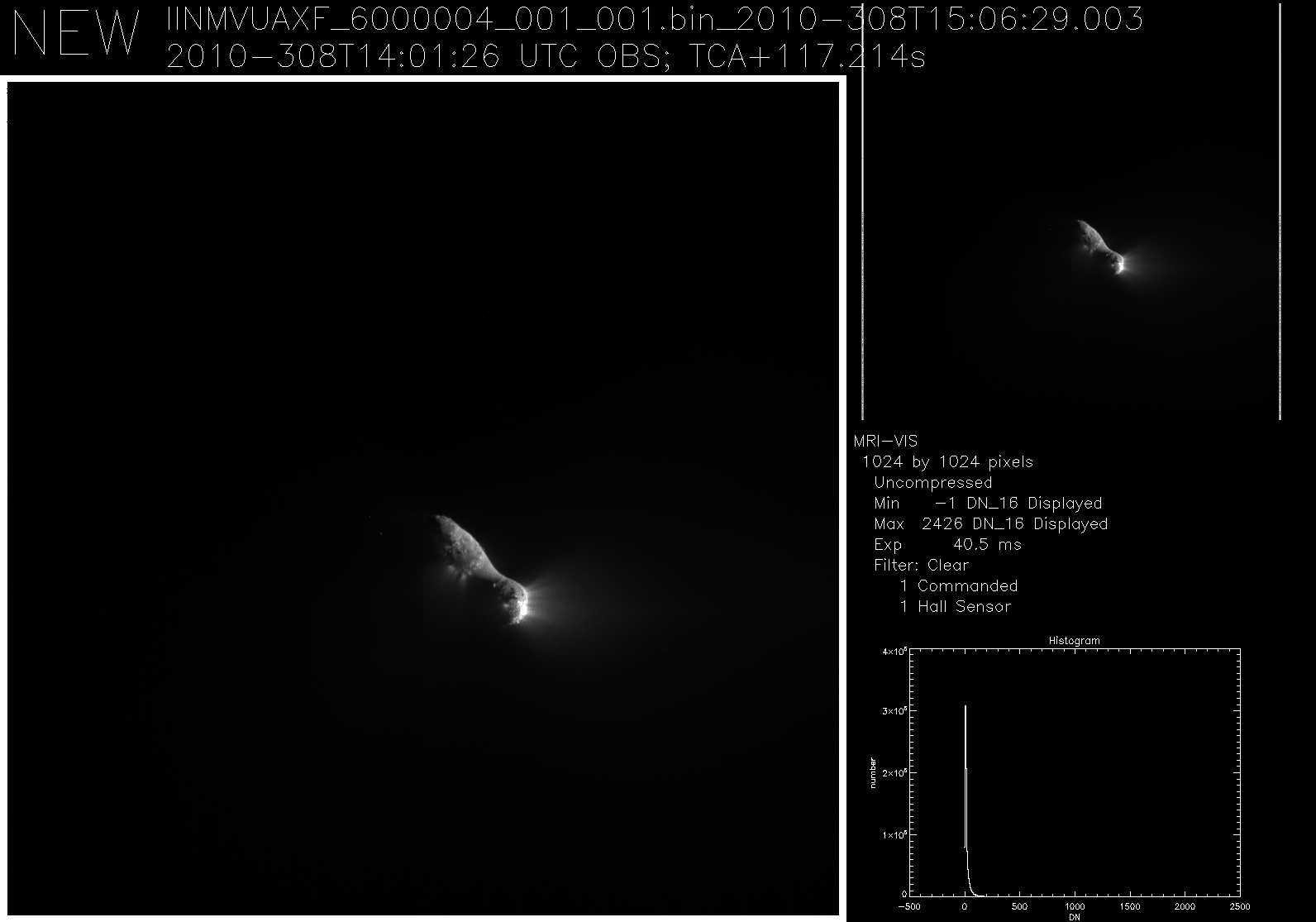 Here's the link to the EPOXI mission web site where there are more images of the venting comet. And here's a nice short article: New Super Close-Up Images From Comet Flyby, and an informative video.
UPDATE: Here are several of the best views in a NASA graphic (click to enlarge):
 And here's a neato animation using the time sequenced images.
UPDATE: Here are several of the best views in a NASA graphic (click to enlarge):
Monday, November 1, 2010
Flyby of active incoming comet...
on track for 4 November rendezvous: NASA Spacecraft Hurtles Toward Active Comet Hartley 2. Here are some radar images acquired at Arecibo.
Friday, October 1, 2010
A close encounter with Comet 103P/Hartley 2...
will occur later this month when the glowing object passes within 11.2 million miles of Earth on 20 October 2010. It's already visible in small telescopes and binoculars, and it should become a naked eye object if observed from a rural location. More information about its rapid approach can be found here and here.
NASA's Deep Impact spacecraft is already beaming back images of this target object, and should pass within about 600 miles of Hartley 2 in early November. Stay tuned for more images!
UPDATE: Here's an excellent finder chart and, for astro geeks, ephemeris data.
NASA's Deep Impact spacecraft is already beaming back images of this target object, and should pass within about 600 miles of Hartley 2 in early November. Stay tuned for more images!
UPDATE: Here's an excellent finder chart and, for astro geeks, ephemeris data.
Friday, June 4, 2010

Monday, March 15, 2010
Something to consider...
when founding your dynasty: Orange Dwarf Star Confirmed to be On Collision Course With Earth. We're all gonna die:
"Our solar system's 'hood may get a bit rougher sometime during the next 1.5 million years. An astronomer has given an 86 percent chance for a neighboring star to smash into the frozen Oort Cloud surrounding the outskirts of the solar system, and may scatter some comets toward Earth."More here. Stay calm. Don't panic.
Thursday, November 12, 2009
Not a computer generated graphic...
 from a recent sci-fi flick but an actual image of Earth acquired by the Rosetta spacecraft (click to enlarge). The European Space Agency mission is on its way to intercept comet 67P/Churyumov-Gerasimenko where it will place a lander on the comet’s surface in 2014.
Stunning and ethereal.
Credit: ESA ©2009 MPS for OSIRIS Team MPS/UPD/LAM/IAA/RSSD/INTA/UPM/DASP/IDA.
Monday, August 17, 2009
Amino acid glycine...
found in dust particles sampled from comet Wild 2 that was returned to Earth by NASA's Stardust spacecraft. Key bit:
"Glycine is an amino acid used by living organisms to make proteins, and this is the first time an amino acid has been found in a comet," said Dr. Jamie Elsila of NASA's Goddard Space Flight Center in Greenbelt, Md. "Our discovery supports the theory that some of life's ingredients formed in space and were delivered to Earth long ago by meteorite and comet impacts."Wow. This certainly bolsters the view that life - as we know it - may be more common in the universe than thought. I wonder what Fred Hoyle would have thought?
Monday, August 10, 2009
Dissipating impact scar...
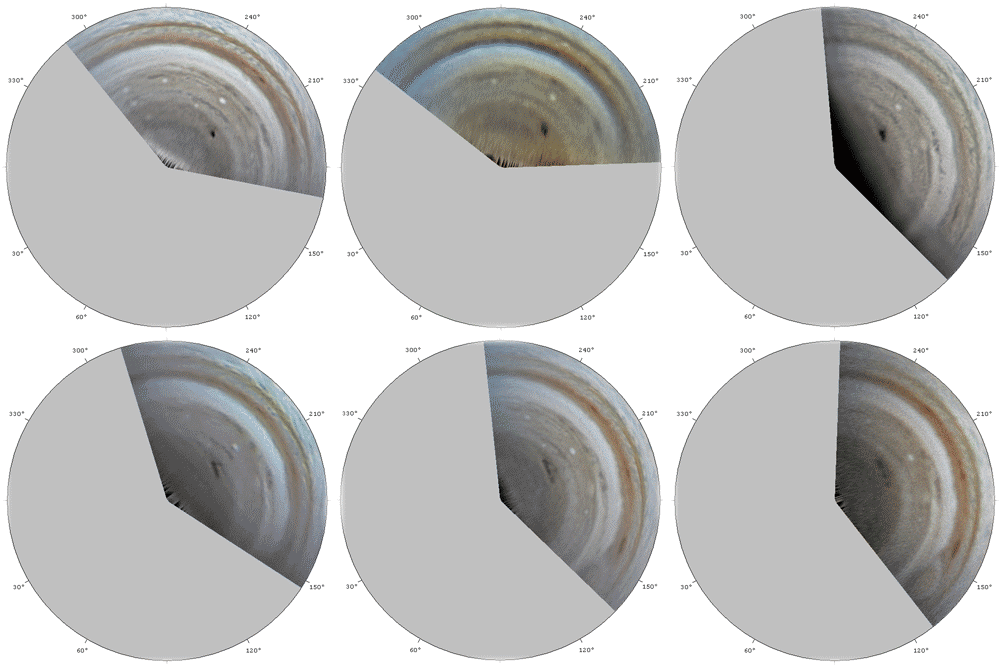 near the south polar region of Jupiter, presented as a time lapse move spanning the last three weeks. The impact site is marked by the black smudge, just to the upper right of center. A series of still images have been converted to polar projection and stitched together by clever amateur astronomers, and presented courtesy of Spaceweather.com.
Related previous post.
Thursday, May 7, 2009
When comets attack...
you better watch out, especially if the "Tunguska event" of 1908 is any indication. Here's a new twist to the long accepted idea that a fragment of a comet or asteroid exploded in the atmosphere over Siberia, leveling ~ 800 square-miles of forests, in what was the largest non-nuclear explosion in recent history.
Hint: a big part of the object still exists. Guess where it is?
Hint: a big part of the object still exists. Guess where it is?
Saturday, April 25, 2009
Armageddon calculator:
Earth Impact Effects Program. You pick the distance from the impact site, the projectile, impact and target parameters, and voila, it determines how you'd die. Link to scientific article that is the basis for the calculator (large .pdf file.)
Almost as much fun as a video game.
Almost as much fun as a video game.
Saturday, February 28, 2009
Faint green smudge...

shown in this image is Comet Lulin as it passes Regulus, the brightest star in the constellation Leo (click to enlarge.) This is a lousy image, plain and simple, but I post it to show that stars do indeed have "color" that reflects their temperature, and the comet is glowing green as cyanogen (CN) gas is volatilized from its nucleus and the ions excited in the solar wind. I captured this image the evening of 27 February: 1 min exposure on non-tracking mount, ISO 1600, f/2.8, Canon 30D with 300 mm telephoto lens.
Monday, February 23, 2009
Comet Lulin...
is frustrating me, or more correctly, the weather is frustrating my efforts at photography. So, here's a terrific photo-gallery of images from across the world. I'm still going to keep trying but the weather forecast doesn't look good. Dang.
Thursday, February 19, 2009
Comet C/2007 N3 Lulin...

is fast approaching and the weekend weather forecast looks pretty good. Here is a finder chart for the coming weeks (click to enlarge.) I downloaded the latest ephemeris (orbital data) and created this sky map showing the trajectory of the comet across the southern sky - simply look south with the chart in front of you. Unfortunately one has to wake up at 4 am to see this interesting object, which eliminates most students. No telescope necessary, but binoculars are helpful.
Link to more information about Comet Lulin.
Link to more information about Comet Lulin.
Monday, February 9, 2009
Comet Lulin...
is now a naked eye object in the constellation Libra and its closest approach to Earth (0.41 AU - less than half the distance of Earth to the Sun) will occur on 24 February. You'll have to be an early riser to see this object, preferably from an observation point far from city lights.
Information sheet (description and sky maps.)
I'm keeping track of this comet, and the weather, and will strive to take an image or two in the weeks ahead. If I am successful I will post it here.
Information sheet (description and sky maps.)
I'm keeping track of this comet, and the weather, and will strive to take an image or two in the weeks ahead. If I am successful I will post it here.
Subscribe to:
Posts (Atom)

