
 for your next geo-geek party, including ankylosaurus, brontosaurus, parosaurolophus, pteranodon, stegosaurus, T-Rex (tyrannosaurus rex), triceratops, and velociraptor. Get 'em here, and don't pass up the dinosaur cookie cutter.
Sunday, January 3, 2010
Dinosaur chopsticks...
for your next geo-geek party, including ankylosaurus, brontosaurus, parosaurolophus, pteranodon, stegosaurus, T-Rex (tyrannosaurus rex), triceratops, and velociraptor. Get 'em here, and don't pass up the dinosaur cookie cutter.


Six years...
 on Mars: Spirit Faces Uncertain Future As Sixth Anniversary Nears. NASA/JPL staff gimmicked this photo (click to enlarge) by artificially inserting the robotic geologist in an image taken on the 438th Martian day (27 March 2005) while it was exploring the Columbia Hills in Gusev Crater.
Saturday, January 2, 2010
Number nerds rejoice...
in today's palindromic date: 01-02-2010. Here's a list of more palindromic dates in the 21st century.
Enjoy!
Enjoy!
Friday, January 1, 2010
Don't blame the technology...
but know its limitations and exercise common sense: GPS Leads 3 Parties Astray in Oregon.
I liken this to using a table saw in a wood shop - it can cause great harm if you're inattentive or using it incorrectly. That's certainly not the tool's fault, but the person operating the equipment.
Previous related post.
I liken this to using a table saw in a wood shop - it can cause great harm if you're inattentive or using it incorrectly. That's certainly not the tool's fault, but the person operating the equipment.
Previous related post.
Thursday, December 31, 2009
Now this is interesting...
department: No Rise of Atmospheric Carbon Dioxide Fraction in Past 160 Years, New Research Finds. Here's the technical abstract in Geophysical Research Letters.
Hmm.
Hmm.
What a difference...

By the way, my spray painted editorial elicited a lot of response from local drivers.
A rare Blue Moon...
occurs this evening, the second full Moon during the month of December. Rarer still, a Blue Moon on New Year's Eve occurs only once every 20 years. Learn more here. And, um, don't expect the Moon to be blue.
So, party on as we begin another lap around the Sun. Happy New Year.
So, party on as we begin another lap around the Sun. Happy New Year.
Wednesday, December 30, 2009
Is the Gregorian calendar...
obsolete? An interesting take: Time and Again, the Calendar Comes Up Short.
Tuesday, December 29, 2009
Monday, December 28, 2009
Aerial views of eolian systems...
in a photogallery at Wired.com: Sublime Sand: Desert Dunes Seen from Space.
The high resolution images are, well, sublime.
The high resolution images are, well, sublime.
E-books outsell real books...
at Amazon.com on Christmas day, attributed to the record number of Kindle readers being given as gifts.
Here's the official press release which includes an interesting insight into what people were buying this commercial holiday season.
Here's the official press release which includes an interesting insight into what people were buying this commercial holiday season.
Sunday, December 27, 2009
Don't be a sucker...
 but use wet adhesion instead: Sucker-Footed Bats Actually Don’t Use Suction. Unlike most bats the diminutive Myzopoda aurita, shown above (click to enlarge), roosts with its head oriented upward.
Remember: bats need friends.
Saturday, December 26, 2009
Compilation of stunning satellite images...
of Earth from Landsat 7. Most of these images are from the USGS/NASA web site Our Earth as Art.
Friday, December 25, 2009
Christmas Tree Cluster...
 in the constellation Monoceros is shown in this image captured by the National Science Foundation's 0.9-meter telescope on Kitt Peak with the NOAO Mosaic CCD camera (click to enlarge). Collectively, the four astronomical objects in this image are referred to as NGC 2264.
Image credit: NRAO/AUI/NSF and NOAO/AURA/NSF.
Thursday, December 24, 2009
This well-monitored field site...

located near Castle Valley, Utah is part of a USGS-directed program in assessing the impact and change to microbiotic soils. And here's an excellent document on biological soil crusts (303 MB .pdf file).
Wednesday, December 23, 2009
Happy Festivus everyone!
Tuesday, December 22, 2009
Fremont's mahonia...

(Mahonia fremontii) is arguably the most Christmas-y looking desert plant there is, somewhat resembling holly (click to enlarge).
Monday, December 21, 2009
Friends I met on the trail...

Winter commences today...
at 17:47 Universal Time (12:47 pm EST) when the Sun reaches its southernmost point below the celestial equator. The shortest day. And the longest night. (In the northern hemisphere, that is.) Learn more about the winter solstice.
So, have a happy solstice, everyone. The days are only going to start to get longer. Cheers.
So, have a happy solstice, everyone. The days are only going to start to get longer. Cheers.
Sunday, December 20, 2009

The raw, unmanipulated data...

from nearly eight years of groundwater monitoring of five wells in the Rathdrum Prairie, Idaho (click to enlarge). The gaps represent points of time when the wells were being used for summer irrigation, or inaccessible due to snow, or I was traveling. Note, since 2004, the significant rising trend in the surface of the water table in all of the wells.
[Perhaps global climate change since 2004 is the cause for the increase. Heh.]
[Perhaps global climate change since 2004 is the cause for the increase. Heh.]
Saturday, December 19, 2009
End of the world on standby...
as the Large Hadron Collider (LHC) temporarily shuts down after initial testing and calibration runs.
That will, at least, allow everyone to enjoy the holidays.
That will, at least, allow everyone to enjoy the holidays.
Ice jam on the Colorado River...

shown above is evocative of the icy surface of Europa, one of the many moons of Jupiter, as shown below.
 (Click each image to enlarge.) Note, in both cases, the larger blocks of ice that have separated and rotated, then frozen within a slushy matrix.
Excellent technical paper: Evidence for a subsurface ocean on Europa (.pdf file).
Friday, December 18, 2009
The corrrelation between geology...
and beer explained at Wired.com: Why Geologists Love Beer.
Alas, I must be an outlier, as I prefer a good single malt Scotch (or blue agave tequila) or a fine red wine (especially a nice Rioja Gran Reserva). Dang, it's too early in the day to tip a drink.
UPDATE: And this bit of advice: Don't be uncouth by adding ice to a good single malt.
Alas, I must be an outlier, as I prefer a good single malt Scotch (or blue agave tequila) or a fine red wine (especially a nice Rioja Gran Reserva). Dang, it's too early in the day to tip a drink.
UPDATE: And this bit of advice: Don't be uncouth by adding ice to a good single malt.
Tear-pants weathering...

is the informal term given to this sharply-pinnacled surface texture found on carbonates in arid climates (it's actually a form of micro-karst; click to enlarge). And it's appropriately named, too. I sure wouldn't want to take a tumble on this surface, especially in shorts and t-shirt.
Wise words...
The whole of science is nothing more than a refinement of everyday thinking.
-- Albert Einstein
-- Albert Einstein
Thursday, December 17, 2009
Commanding view of Moab...

Wednesday, December 16, 2009
Free McWi-Fi...
with your cheeseburger: McDonald’s To Offer Free Wi-Fi At Most Locations.
Bravo! More businesses should follow this example.
Bravo! More businesses should follow this example.
Spokane's "unusual water supply"...

was mentioned in a 1930 article in the short-lived The Spokane Woman newspaper (click to enlarge), a relict accidentally discovered by a former student of mine. Here's his account of this interesting find:
"So I was sledge hammering my basement apart today and found an entire intact copy of an old local publication called "The Spokane Woman" that was being used as a shim for framing a door opening. The first page had a caption about the mysterious source of Spokane's water.Enjoy,
Deacon"
We know today - 80 years later - that Spokane is indeed fortunate, with a bountiful water supply provided by the sole-source Spokane aquifer.
Thanks, DB, for sharing this with me, and the readers of this blog.
Thanks, DB, for sharing this with me, and the readers of this blog.
What I'm reading...
right now: The Arctic Grail by Pierre Berton. This tome is a historical recount of the period 1818-1909 during the quest for the elusive North West Passage through the Arctic Ocean.
The book is a gift from colleague RQ who attended my Sigma Xi talk last month about my travels above the Arctic Circle and who shares a similar interest in the polar north. Thanks, Bob!
The book is a gift from colleague RQ who attended my Sigma Xi talk last month about my travels above the Arctic Circle and who shares a similar interest in the polar north. Thanks, Bob!
A worthwhile essay...
at The Scientist: Promises, Promises. "Ill-judged predictions and projections can be embarrassing at best and, at worst, damaging to the authority of science and science policy."
And know this: computer models are not facts.
And know this: computer models are not facts.
Tuesday, December 15, 2009

Monday, December 14, 2009
There he goes again...
exaggerating global climate change: Inconvenient truth for Al Gore as his North Pole sums don't add up. To wit:
In his speech, Mr Gore told the conference: “These figures are fresh. Some of the models suggest to Dr [Wieslav] Maslowski that there is a 75 per cent chance that the entire north polar ice cap, during the summer months, could be completely ice-free within five to seven years.”To which Dr. Maslowski had this to say:
“It’s unclear to me how this figure was arrived at,” Dr Maslowski said. “I would never try to estimate likelihood at anything as exact as this.”Hey, facts never seem to have gotten in the way of Gore's spinning. Here's yet another recent example. And let's not forget this gem either.
Magma conduit beneath Yellowstone...
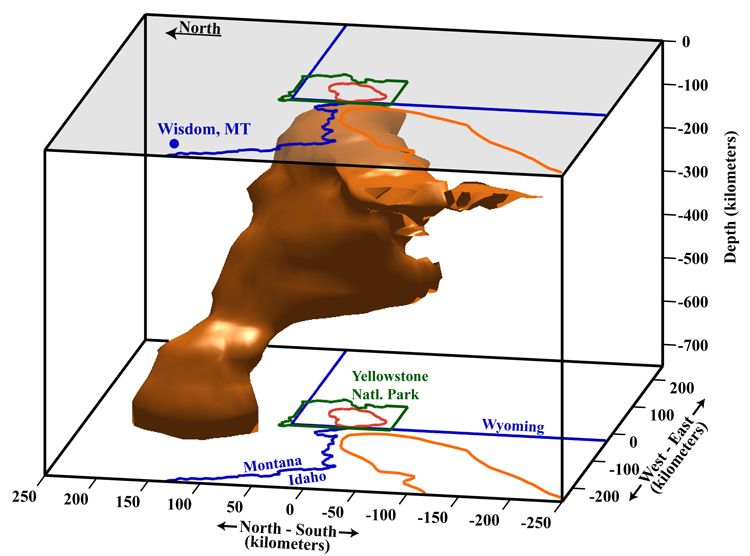 presented as a three-dimensional model by researchers at the University of Utah (click to enlarge). Here are general articles, here and here, that describe this recent work performed by the Seismology and Active Tectonics Research Group that used seismic and gravimetric data to create the plume model.
Amazingly, the conduit appears to be plumbed as deeply as 410 miles. The research also reveals this surprise:
"The study's of Yellowstone's plume also suggests the same "hotspot" that feeds Yellowstone volcanism also triggered the Columbia River "flood basalts" that buried parts of Oregon, Washington state and Idaho with lava starting 17 million years ago."Image credit: UUSATRG.
Natural ventilation of caves...
may affect speleothem growth rates according to a recent study. Link to technical abstract.
Subscribe to:
Posts (Atom)
