
 this term occurs tomorrow at 2 pm. Remember: groundwater doesn't always flow from high potential to low potential, it increasingly flows toward money.
Sunday, January 31, 2010
First hydrogeology exam...
this term occurs tomorrow at 2 pm. Remember: groundwater doesn't always flow from high potential to low potential, it increasingly flows toward money.


Peer review...
is for the little people: UN climate change panel based claims on student dissertation and magazine article.
And this: Climate Chief Hid False Glacier Claims At Summit.
Sheesh.
UPDATE: UN climate panel shamed by bogus rainforest claim.
Unbelievable. Will there be any accountability on behalf of the IPCC?
And this: Climate Chief Hid False Glacier Claims At Summit.
Sheesh.
UPDATE: UN climate panel shamed by bogus rainforest claim.
Unbelievable. Will there be any accountability on behalf of the IPCC?
Saturday, January 30, 2010
Black bears prefer minivans...
in Yosemite National Park: SELECTIVE FORAGING FOR ANTHROPOGENIC RESOURCES BY BLACK BEARS: MINIVANS IN YOSEMITE NATIONAL PARK.
Fascinating study about some very intelligent bears.
Fascinating study about some very intelligent bears.
Ownership battle brews...
over Virginia meteorite that crashed through the roof of a medical building earlier this month.
It's never a good thing when lawyers get involved.
It's never a good thing when lawyers get involved.
One megajoule barrier...
has been surpassed: Laser Fusion Test Results Raise Energy Hopes.
Read more about the National Ignition Facility project. Here's the significance:
Faster, please.
Read more about the National Ignition Facility project. Here's the significance:
"The peak power of the laser light, which was delivered within a few billionths of a second, was about 500 times that used by the United States at any given time."Wow.
Faster, please.
Friday, January 29, 2010
Dune and interdune environments...
 imaged on Mars inside a crater in Noachis Terra (click to enlarge). Link to NASA press release that describes this impressive image.
RELATED: Shameless self promotion: I will be presenting my talk on the geology of Mars and how it relates to the channeled scablands in eastern Washington next week at Central Washington University. See the Calendar section in the right side bar for details.
Image credit: High Resolution Imaging Science Experiment (HiRISE) camera on NASA's Mars Reconnaissance Orbiter.
A critical evaluation...
of surface temperature monitoring networks: Surface Temperature Records: Policy Driven Deception? (6.1 Mb .pdf file)
UPDATE: Previous related post.
UPDATE: Previous related post.
The perigee Moon...
 occurs this evening, resulting in the largest full Moon of 2010. Since Luna's orbit around Earth is elliptical it will position the Moon ~50,000 km closer to Earth this month, resulting in an orb that is 14% wider and 30% brighter than any other full Moon the rest of the year. Shown above are comparative images of the Moon taken in 2004 during perigee and at apogee (click to enlarge).
Oh yeah, that bright orange "star" next to the Moon tonight is Mars (see post below).
Image credit: Anthony Ayiomamitis
Thursday, January 28, 2010
How do you learn?
Find out by taking the learning styles quiz, and use the results to hone your studying strategies.
Me? I'm a visual learner, doing best with reading and seeing images/diagrams, remembering things by sight.
Hat tip: CN.
Me? I'm a visual learner, doing best with reading and seeing images/diagrams, remembering things by sight.
Hat tip: CN.
Wednesday, January 27, 2010
Wise words...
The true logic of this world is in the calculus of probabilities.
-- James Clerk Maxwell
-- James Clerk Maxwell
Closest approach of Mars...
to Earth occurs today, when our neighbor in the solar system will be only 61.7 million miles (99 million km) away, closer than it will be again until March 2014.
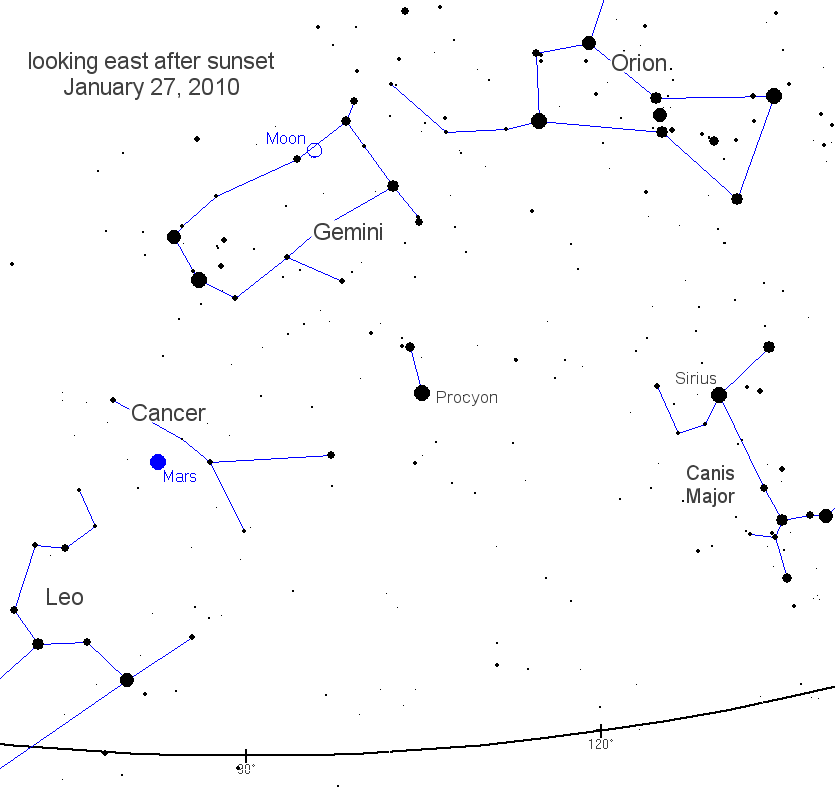 Peaking at magnitude -1.3, Mars will outshine all stars and other planets (except Sirius and Jupiter). Use the star chart provided above (click to enlarge) to find the red planet in the early evening night sky. Read more here about this opportunity to observe Mars up close.
Image credit: Star chart courtesy Spaceweather.com.
Peaking at magnitude -1.3, Mars will outshine all stars and other planets (except Sirius and Jupiter). Use the star chart provided above (click to enlarge) to find the red planet in the early evening night sky. Read more here about this opportunity to observe Mars up close.Image credit: Star chart courtesy Spaceweather.com.
Tuesday, January 26, 2010
Get used to the view...
since your roving days are over: NASA Abandons Escape Attempts for Stuck Mars Rover. More here and here.
This really comes as no surprise, and Spirit will continue to serve as a fixed science and meteorological station if it is able to muster sufficient solar energy to get it through the coming Martian winter.
This really comes as no surprise, and Spirit will continue to serve as a fixed science and meteorological station if it is able to muster sufficient solar energy to get it through the coming Martian winter.
Just like clockwork...
a trumpeter swan returns to Turnbull National Wildlife Refuge south of campus.
I might have to wander out to shoot him. With my camera.
I might have to wander out to shoot him. With my camera.
Extraordinary coronal detail...
 captured in stunning images acquired during a total solar eclipse earlier this month (click to enlarge). Read more about the Sun's corona.
Awesome.
Image credit: Miloslav Druckmüller.
Massive earthquake strikes Pacific northwest...
310 years ago on this date: Jan. 26, 1700: Northwest Quake Unleashes Trans-Pacific Tsunami.
And, take note of this: "There is evidence of at least 13 events at intervals from about 300 to 900 years with an average of 590 years." So another big one is increasingly probable as time passes.
And, take note of this: "There is evidence of at least 13 events at intervals from about 300 to 900 years with an average of 590 years." So another big one is increasingly probable as time passes.
Monday, January 25, 2010
A certain textbook publisher...
is visiting our department today (one of the larger, well known companies), plying faculty members with a generous lunch, as they present their titles to us for consideration for adoption in our courses. This is likely common business practice, much like drug reps treating medical doctors to lunch during office sales visits. But I still question if this is ethical?
For what it's worth, I'm not participating. I don't see how this reduces (or at least limits the rate of increase) the price of textbooks to students, and in fact, it likely results in the opposite.
For what it's worth, I'm not participating. I don't see how this reduces (or at least limits the rate of increase) the price of textbooks to students, and in fact, it likely results in the opposite.
Climate melt-down continues...
Glacier scientist: I Knew Data Hadn't Been Verified.
Previous related post.
RELATED: Global warming ranks dead last as a public priority according to this Pew poll. Seems about right to me, especially since it's increasingly based on poor science and fear mongering, as well as a diminishing public trust of scientists.
UPDATE: Scientists accused of using selective temperature data.
It's time to get your bake on...

Heads up, geo-students! You can compete, too.
Pop, snap, pop...
Bubble Wrap Celebrates 50th Birthday
Admit it - you've spent some delightful time popping bubble wrap. Hey, we all have - it's cathartic.
Admit it - you've spent some delightful time popping bubble wrap. Hey, we all have - it's cathartic.
Good for them...
Taking Down the Dinosaur Thief
"A rare and nearly complete dinosaur skeleton stolen from private property in Montana and stored in an evidence locker for more than two years has been turned over to researchers."
Wise words...
Science has 'explained' nothing; the more we know the more fantastic the world becomes and the profounder the surrounding darkness.
-- Aldous Huxley
-- Aldous Huxley
Sunday, January 24, 2010
Naica Crystal Cave video...
being shot by the BBC as part of a new television series "How Earth Made Us."
Previous related posts about this amazing cave located in a deep Mexican silver mine, and its gigantic gypsum crystals, can be found here and here.
Upcoming local lecture...
of potential interest to geo-geeks:
Bill is an EWU geology alum, having earned his Masters degree in the late 1980s, and was one of my first graduate advisees.
"Forensic Geology in Columbia"
Mr. William Schneck
Thursday, 28 January, at noon
Washington State Crime Laboratory
on the EWU campus
Saturday, January 23, 2010
March of the penguin appetizers...

for a small dinner party this evening, prepared this afternoon by my friend RT and me (click to enlarge). These diminutive characters consist of carrots, olives and cream cheese and take a little time to assemble.
I can't wait to bite their tiny heads off.
I can't wait to bite their tiny heads off.
Friday, January 22, 2010
It's the first field work Friday...
of the new year as I continue to gather groundwater level data for monitoring wells in the Rathdrum Prairie, Idaho. Here's a graphic showing nearly eight years of measurements based on these monthly efforts.
Watch out...
from above: Lorton Meteorite, The Fourth Observed To Fall In Virginia. It's the real deal:
"A meteorite, the size of a mango, punched through the ceiling of the Williamsburg Square Family Practice Office in Lorton."The office was occupied at the time of the impact, and fortunately nobody was injured. Good video at the link.
Thursday, January 21, 2010
Other than that...
it was accurate! UN Climate Report Riddled With Errors on Glaciers
A 2007 IPCC report, ostensibly written by "Nobel Prize-winning panel of climate scientists," contained no less than five glaring errors in a single paragraph:
"Cogley, who wrote a letter about the problems to Science magazine that was published online Wednesday, cited these mistakes:
• The paragraph starts, "Glaciers in the Himalayas are receding faster than in any other part of the world." Cogley and Michael Zemp of the World Glacier Monitoring System said Himalayan glaciers are melting at about the same rate as other glaciers.
• It says that if the Earth continues to warm, the "likelihood of them disappearing by the 2035 and perhaps sooner is very high." Nowhere in peer-reviewed science literature is 2035 mentioned. However, there is a study from Russia that says glaciers could come close to disappearing by 2350. Probably the numbers in the date were transposed, Cogley said.
• The paragraph says: "Its total area will likely shrink from the present 500,000 to 100,000 square kilometers by the year 2035." Cogley said there are only 33,000 square kilometers of glaciers in the Himalayas.
• The entire paragraph is attributed to the World Wildlife Fund, when only one sentence came from the WWF, Cogley said. And further, the IPCC likes to brag that it is based on peer-reviewed science, not advocacy group reports. Cogley said the WWF cited the popular science press as its source.
• A table says that between 1845 and 1965, the Pindari Glacier shrank by 2,840 meters. Then comes a math mistake: It says that's a rate of 135.2 meters a year, when it really is only 23.5 meters a year."
Previous related post.

Wednesday, January 20, 2010
Diamond oceans...
possible on Uranus and Neptune, with "solid diamond icebergs."
This doesn't bode well for the hyper-inflated diamond market on Earth. Watch out De Beers.
RELATED: Makes this one seem pretty puny.
This doesn't bode well for the hyper-inflated diamond market on Earth. Watch out De Beers.
RELATED: Makes this one seem pretty puny.
Tuesday, January 19, 2010
That's why they're called...

Monday, January 18, 2010
Wise words...
Science is the knowledge of consequences, and dependence of one fact upon another.
-- Thomas Hobbes
-- Thomas Hobbes
Sunday, January 17, 2010
Building a high-tech instrument...
for the next Mars rover, in a clean room, with gloved hands, one itsy bitsy piece at a time. In a couple of words: skill and patience.
Dan Carrigan is the brother of a very good friend of mine, CC, and we've all spent some time together exploring canyon country in southern Utah. He is shown here assembling a component of the Sample Analysis at Mars Instrument Suite (SAM).
Think about the sense of pride and accomplishment he must feel to have a hand in building these one-of-a-kind devices, then to see your instrument launched to various destinations in our solar system and perform, most of the time, flawlessly and for longer periods than originally intended.
Keep up the great work, Dan.
Subscribe to:
Posts (Atom)


